What Is LLMO? Optimize Content for AI & Large Language Model Optimisation
Large Language Model Optimization, or LLMO, is the practice of making content easier for AI systems to discover, understand, retrieve, summarize and cite. It combines proven SEO foundations with clear answers, semantic structure, trustworthy evidence, consistent entity information and technical accessibility. Effective LLMO can improve a brand’s visibility in Google AI Overviews, ChatGPT, Gemini, Microsoft Copilot, Perplexity and other generative search experiences, although no technique can guarantee a particular ranking or citation.
- Reviewed by
- RAASIS Technology
- Last reviewed
- Target market
- India
- Editorial disclosure
- This briefing provides general digital growth information and does not guarantee rankings or commercial outcomes.
Answer summary
The short answer.
Large Language Model Optimization, or LLMO, is the practice of making content easier for AI systems to discover, understand, retrieve, summarize and cite. It combines proven SEO foundations with clear answers, semantic structure, trustworthy evidence, consistent entity information and technical accessibility.…
Large Language Model Optimization, or LLMO, is the practice of making content easier for AI systems to discover, understand, retrieve, summarize and cite. It combines proven SEO foundations with clear answers, semantic structure, trustworthy evidence, consistent entity information and technical accessibility. Effective LLMO can improve a brand’s visibility in Google AI Overviews, ChatGPT, Gemini, Microsoft Copilot, Perplexity and other generative search experiences, although no technique can guarantee a particular ranking or citation. Key Takeaways LLMO helps AI systems find, interpret and accurately reference your content. It extends SEO rather than replacing it. Clear answers, descriptive headings, tables and evidence improve extractability. Crawl access, indexing and page performance remain essential. Consistent brand, author and product information strengthens entity understanding. Original expertise is more valuable than mass-produced generic content. Success should be measured through citations, visibility, referrals, engagement and conversions. Definition Box: Large Language Model Optimization is a content and technical strategy designed to improve how AI-powered systems retrieve, interpret, summarize and cite a brand’s information. It combines searchable web content, answer-first writing, entity clarity, credible sourcing, structured data and strong user experience to increase visibility across generative search platforms. What Is LLMO and Why Does It Matter for AI Search? LLMO addresses a major change in how people find information. A prospective customer may no longer search only for “best CRM software” and visit ten blue links. They might ask ChatGPT, Gemini or Perplexity, “Which CRM is best for a 20-person consulting company that needs automation but has no internal IT team?” That question contains a goal, company profile, constraint and evaluation requirement. The AI system must break it into subtopics, retrieve relevant information and construct an answer. Content that clearly explains who a solution is for, what it does, how it differs and where its limitations lie is easier to use than vague promotional copy. LLMO therefore improves three kinds of visibility: Discovery: Can search engines and AI crawlers access the content? Understanding: Can the system identify the topic, brand, people, services and relationships? Selection: Is the content sufficiently relevant, clear and trustworthy to support an answer? Google states that its established SEO best practices remain applicable to AI Overviews and AI Mode. Pages must be indexed and eligible to appear with a snippet, but Google requires no special AI schema or machine-readable “AI file.” Its AI features may also use query fan-out, running related searches across several subtopics before constructing an answer. Google Search Central This makes comprehensive topic coverage important—but “comprehensive” does not mean long for the sake of length. It means resolving the main question, foreseeable follow-up questions and decision criteria without forcing readers to search again. How Large Language Model Optimization Works LLMO works by reducing the effort required to retrieve and interpret useful information. An AI system does not reward a page simply because it repeats a keyword. It must first discover the page, identify relevant passages and assess whether those passages can reliably support the requested answer. The five-stage LLMO model Crawl: A search crawler or AI-specific bot reaches the page. Index or retrieve: The system stores, processes or fetches the content. Interpret: It identifies entities, topics, claims and relationships. Select: Relevant passages are chosen for the user’s question. Present: The platform summarizes, quotes, links to or cites the source. Weakness at any stage can reduce visibility. Excellent writing cannot compensate for a blocked crawler. Perfect schema cannot rescue shallow information. A fast page will not earn trust if its claims are unsupported. What makes a passage citation-ready? A strong passage usually has: A descriptive heading matching a genuine question A direct answer in its opening sentence Enough context to make sense outside the article Specific examples, conditions or limitations Evidence or a clearly attributable expert perspective Plain language with limited ambiguity For example, “LLMO improves visibility” is too general. A more useful statement is: “LLMO can improve AI-search visibility by making important answers crawlable, self-contained, evidence-backed and easy to extract; it cannot guarantee that a platform will cite a particular page.” The second version defines the mechanism and its limitation. That makes it more useful to both readers and retrieval systems. LLMO vs SEO, AEO and GEO: What Is the Difference? LLMO, SEO, AEO and GEO overlap, but each emphasizes a different part of digital discovery. Discipline Primary objective Typical surfaces Core tactics Useful success signals Key limitation SEO Improve organic search visibility Google, Bing and other search engines Crawlability, keywords, links, content and page experience Rankings, impressions, clicks and conversions Rankings do not guarantee AI citations AEO Provide concise answers Featured snippets, voice assistants and answer boxes Direct answers, FAQs and question-led structure Answer-box ownership and qualified visits Can become shallow if reduced to short answers GEO Earn inclusion in generative answers AI Overviews, Copilot and generative search Evidence, topical depth, clarity and citations Mentions, citations and referral traffic Measurement differs by platform LLMO Improve machine understanding and retrieval ChatGPT, Gemini, Perplexity and other LLM interfaces Entity clarity, passage design, evidence and access Citation frequency, answer presence and conversions There is no universal LLM ranking formula Content SEO Match search demand with useful pages Search results and content discovery Search intent, topic clusters and internal linking Non-brand traffic and engagement Traffic alone may not produce business value Entity SEO Clarify who or what a brand represents Knowledge systems and semantic search Consistent facts, author profiles and corroboration Better brand recognition and query association Requires consistency beyond one page
The strongest strategy integrates all six perspectives. SEO creates the discovery foundation. AEO makes answers concise. GEO targets generative experiences. LLMO improves retrieval and interpretation. Content SEO maps demand, while entity SEO strengthens identity. Google explicitly says there are no additional technical requirements for inclusion in AI Overviews or AI Mode beyond established Search eligibility. That is why LLMO should be treated as a disciplined extension of helpful SEO—not a shortcut or replacement. How to Build an Effective LLMO Content Strategy A successful LLMO program begins with audience questions, not a list of high-volume keywords. AI search often reflects complex needs expressed in natural language, so the content plan must address decisions, comparisons, risks and next actions.
- Map conversational demand
Collect questions from: Sales calls and customer-support conversations Search Console queries Community discussions and product reviews On-site search data People Also Ask results AI-platform prompts relevant to the buying journey Competitor pages that already attract qualified visibility Group those questions by task. A software company might organize them into evaluation, implementation, integration, pricing, security, migration and troubleshooting clusters.
- Assign one clear purpose to each page
Avoid creating five thin articles that answer almost the same question. Build one authoritative page for the central intent, then support it with narrower articles where the user’s need genuinely differs. Each page should have: One primary intent One descriptive H1 A direct answer near the beginning Logical H2 and H3 sections Original expertise or evidence Relevant internal links A next step aligned with the reader’s stage
- Create an information-gain requirement
Before publishing, ask what the page adds beyond existing results. Useful additions may include a proprietary framework, implementation checklist, annotated example, expert observation, decision tree, test result or carefully qualified point of view. Google’s people-first guidance emphasizes original information, substantial coverage, trustworthy authorship and content that leaves readers feeling they have learned enough to achieve their goal. It also warns against producing content merely to capture search traffic or meet an arbitrary word count. Google Search Central Soft CTA: If your current content library contains overlapping, generic or difficult-to-measure articles, RAASIS TECHNOLOGY can help turn it into a focused AI-search content system built around real customer questions. How to Optimize Content for AI and Large Language Models Effective AI content optimization happens at the passage level. Every important section should be understandable even when retrieved without the preceding paragraphs. Use an answer-first structure Open each major section with a one- or two-sentence answer. Follow it with explanation, evidence, examples and exceptions. A reliable structure is: State the answer. Explain why it is true. Show how it works. Give an example. Clarify limitations. Recommend the next action. Write for questions, not keyword variations Do not create separate sentences solely to force phrases such as “LLMO services,” “best LLMO company” and “LLMO agency worldwide.” Address the underlying decision instead: Who needs LLMO? What does implementation involve? How is it measured? How long does improvement take? What can prevent a site from being cited? How does LLMO support revenue? Semantic breadth comes from complete explanations, not synonym stuffing. Make important claims verifiable Link to primary sources where possible. Attribute research accurately. Show dates when freshness matters. Distinguish evidence from opinion and disclose relevant commercial relationships. Real expertise is often visible through details: what failed, which constraint changed the outcome, how the process was tested and when a recommendation does not apply. These details make content more credible and harder to imitate. Use useful formats AI-friendly formatting also improves human scanning: Tables for exact comparisons Numbered steps for processes Bullets for criteria and checklists Definition boxes for terminology Examples for abstract recommendations Descriptive image captions and alt text Short summaries after complex sections The goal is not to write mechanically. It is to make meaning explicit. Technical LLMO: Crawling, Indexing, Schema and Performance Technical LLMO ensures that the content you create can actually be reached and processed. Manage crawler access deliberately Google uses Googlebot access and normal Search controls for its AI search features. OpenAI advises publishers not to block OAI-SearchBot if they want content included in ChatGPT search summaries and snippets. It treats GPTBot, which relates to potential model training, separately. OpenAI’s publisher guidance Perplexity similarly identifies PerplexityBot as its search crawler and publishes crawler information and IP ranges for verification. Perplexity crawler documentation Review robots.txt, meta robots directives, CDN settings and web-application firewall rules. A crawler allowed by robots.txt can still be blocked by an aggressive security rule. Keep essential information in accessible text Do not hide the only version of a critical answer inside an image, video, downloadable PDF or interaction that requires a click. Provide a meaningful HTML text equivalent. Use semantic HTML, descriptive navigation and accessible labels. This helps users, conventional crawlers and systems that interpret a page through its structure. Apply accurate structured data For an article like this one, appropriate BlogPosting or Article structured data can specify the headline, author, representative images, publication date and modification date. Google says this markup can help it understand article details, but it does not guarantee a particular search feature. Google’s Article structured-data guidance Structured data must match visible content. Do not mark up reviews, FAQs, services or authors that users cannot see. Protect page experience Measure performance with field data where possible. Google’s current “good” Core Web Vitals thresholds are: LCP within 2.5 seconds INP below 200 milliseconds CLS below 0.1 Google recommends good Core Web Vitals as part of a strong overall page experience, not as a substitute for useful content. Google Search Central Use compressed responsive images, stable dimensions, efficient fonts, limited third-party scripts and sensible caching. Fast access benefits readers and makes large content libraries easier to crawl. How Entity Authority and E-E-A-T Strengthen LLMO An entity is a recognizable person, organization, product, place or concept. Entity optimization helps machines understand that the same business described on its website, profiles, publications and trusted directories is one consistent organization. For a brand, establish: A complete About page Clear legal or business identity Consistent name, services and contact details Author and expert profile pages Relevant credentials and experience Editorial and correction policies Original case studies Trusted third-party references Organization, Person and Article schema where accurate For an influencer or motivational speaker, the entity should connect the individual’s name with subjects, books, appearances, verified profiles and areas of first-hand expertise. E-E-A-T—experience, expertise, authoritativeness and trustworthiness—is best treated as an editorial quality framework. Google explains that E-E-A-T is not one isolated ranking factor and identifies trust as the most important element. Clear authorship, sourcing, experience and purpose help readers evaluate whether information deserves confidence. Consistency matters, but repetition is not authority. Copying the same biography across dozens of low-quality websites is weaker than publishing demonstrable work and earning relevant independent recognition. Soft CTA: Organizations expanding into generative search can use RAASIS TECHNOLOGY’s generative AI development services to connect content strategy, entity architecture, AI experiences and technical implementation. How to Measure LLMO Visibility, Citations and Business Impact LLMO measurement requires more than tracking traditional rankings. A page may earn fewer clicks if an AI interface answers the question directly, yet the people who do click may be further along in their decision. Track four measurement layers: Visibility Presence in AI-generated answers Brand mentions with and without links Share of relevant prompts Number of cited pages Queries associated with citations Search performance Search impressions and clicks Non-brand query growth Indexed-page coverage Featured-snippet ownership Landing-page engagement Referral quality Visits from AI platforms Engaged sessions Assisted conversions Demo requests, calls or downloads Revenue or qualified pipeline Content quality Factual accuracy Freshness Successful task completion Internal search refinement Customer-support reduction OpenAI says ChatGPT referral URLs include utm_source=chatgpt.com, enabling publishers to analyze those visits. Microsoft introduced AI Performance reporting in Bing Webmaster Tools in 2026, including total citations, cited pages, grounding queries and citation trends across supported AI experiences. Microsoft Bing Create a representative prompt set by audience, problem and funnel stage. Test it consistently, record citations and compare changes over time. Do not treat one manually observed answer as a stable ranking because generated answers can vary by platform, location, freshness and phrasing. Common LLMO Mistakes and How to Avoid Them Mistake 1: Treating LLMO as keyword stuffing Repeating “LLM optimization” does not create expertise. Cover the topic naturally, answer adjacent questions and use terminology only where it improves precision. Mistake 2: Publishing generic AI-generated articles A polished summary of existing pages adds little information gain. Add expert review, examples, original frameworks, tested recommendations and brand-specific evidence. Mistake 3: Inventing facts or citations Fabricated statistics destroy trust. Use a primary source, qualify uncertain information or omit the claim. Mistake 4: Creating a separate page for every prompt This causes duplication and cannibalization. Consolidate closely related questions into a strong primary resource and create supporting pages only for distinct intent. Mistake 5: Blocking the wrong crawler Training controls and search-discovery controls may use different user agents. Review each platform’s current documentation before changing robots.txt or WAF rules. Mistake 6: Adding unsupported schema Schema should describe what users can see. More markup is not automatically better, and no special schema guarantees inclusion in an AI answer. Mistake 7: Ignoring conversion intent A citation has limited commercial value if the landing page lacks a relevant next action. Match CTAs to intent: offer a template during research, an audit during evaluation and a consultation when the visitor is ready to act. Mistake 8: Promising guaranteed rankings No agency controls Google, ChatGPT, Gemini or Perplexity. A credible LLMO strategy improves eligibility, relevance and citation readiness while communicating uncertainty honestly. Why RAASIS TECHNOLOGY for LLMO—and Your Next Steps LLMO is most effective when content, technical SEO, structured data, entity strategy, analytics and generative AI development work together. RAASIS TECHNOLOGY can help brands build this integrated foundation rather than treating AI visibility as a collection of isolated content edits. A practical engagement may include: Search and AI visibility assessment Technical crawl and indexation audit Customer-question and prompt research Topic-cluster and information-architecture planning Content briefs and production-ready optimization Entity and author-profile improvements Schema review and implementation Analytics and citation-monitoring framework Generative AI tools or customer experiences Ongoing accuracy, freshness and performance reviews Next Steps Checklist Identify the questions your best prospects ask before buying. Audit which pages already answer those questions. Remove duplication and consolidate overlapping content. Add direct answers, evidence, examples and limitations. Strengthen author, brand and service entity information. Verify Googlebot and relevant AI crawler access. Validate canonical tags, sitemaps and structured data. Improve Core Web Vitals and mobile usability. Track AI citations, referrals, engagement and conversions. Review important content whenever facts or offerings change. LLMO will not replace the fundamentals of relevance, trust and customer value. It makes those fundamentals easier for AI systems to find and communicate. Brands that invest now can create durable assets that serve readers, search engines and generative assistants from the same authoritative source. Ready to improve your visibility across Google AI Overviews, ChatGPT, Gemini, Perplexity and other AI search experiences? Explore RAASIS TECHNOLOGY’s generative AI development services and request a tailored LLMO and AI-search strategy for your organization. Frequently Asked Questions
- What does LLMO mean in digital marketing?
LLMO means Large Language Model Optimization. It describes the process of improving content and technical access so AI systems can discover, understand, retrieve and accurately cite a brand’s information. The practice includes conventional SEO, answer-focused writing, semantic structure, entity consistency, trustworthy evidence and crawler management. LLMO does not guarantee inclusion in an AI response; it improves a page’s eligibility, clarity and usefulness across AI-powered discovery experiences.
- Is LLMO the same as SEO?
No. SEO primarily improves visibility in conventional search results, while LLMO focuses on how large language model applications retrieve and use information when constructing answers. However, the disciplines are closely connected. Crawlability, indexing, internal linking, page experience and helpful content support both. A reliable LLMO strategy builds on SEO and adds passage-level answers, entity clarity, evidence, AI crawler review and citation-focused measurement.
- How do I optimize content for ChatGPT and other AI tools?
Begin by allowing the relevant search crawler, making important information available in accessible HTML and answering real customer questions directly. Use descriptive headings, self-contained explanations, comparison tables, original examples and primary-source citations. Clarify your brand, authors and services across the website. Then measure AI referrals and citations. Avoid artificial keyword repetition, invented data and special markup that does not match visible content.
- Does schema markup improve LLM visibility?
Accurate schema can help search systems understand the type of page and details such as its author, headline, dates, organization and images. It is therefore a useful supporting signal. Schema does not make weak content authoritative and does not guarantee an AI citation or rich result. Use only relevant markup that matches visible content, validate it after implementation and keep structured facts consistent with the rest of the website.
- Do I need an llms.txt file for LLMO?
An llms.txt file is an emerging, voluntary convention rather than a universal requirement for AI-search visibility. Google states that no additional AI text file or special markup is required for its AI search features. Prioritize crawl access, indexable pages, sitemaps, semantic HTML, accurate schema and helpful content first. If you experiment with llms.txt, treat it as a supplementary aid and monitor whether your target platforms officially support it.
- How long does LLMO take to produce results?
There is no fixed timeline. Results depend on existing authority, crawl frequency, competition, technical health, content quality and the platform being monitored. Technical improvements may be detected after recrawling, while stronger topical authority and third-party recognition can take considerably longer. Establish a baseline before implementation, monitor monthly trends and assess citations alongside organic traffic, qualified engagement and conversions rather than expecting an immediate, universal ranking change.
- Can LLMO guarantee a number-one Google ranking or AI citation?
No ethical consultant can guarantee a number-one organic ranking or citation in a generated answer. Search and AI platforms use changing systems, multiple sources and context-dependent retrieval. LLMO improves the probability of visibility by strengthening accessibility, relevance, clarity, evidence and authority. The appropriate goal is sustained growth in qualified discovery, citations, brand mentions, referral quality and business outcomes—not a guaranteed position controlled by an external platform.
Continue the thinking
Related intelligence.
AEO vs GEO vs LLMO: Optimize for Google AI & ChatGPT
AEO vs GEO vs LLMO describes three connected approaches to modern search visibility. AEO structures content to deliver direct answers. GEO improves a source’s likelihood of being…
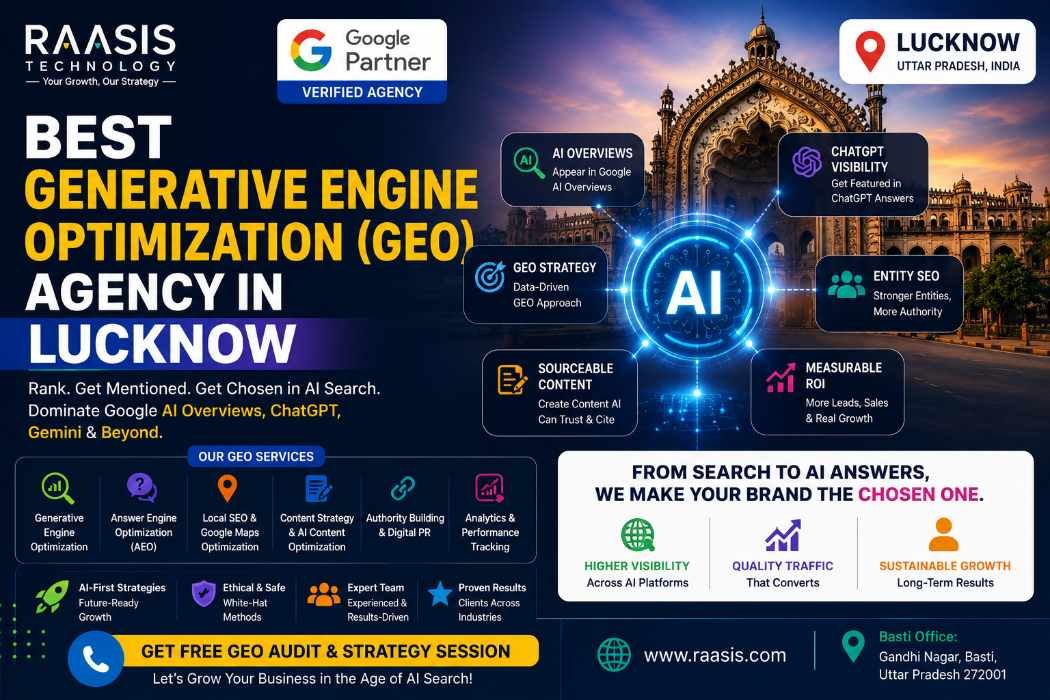
Best Generative Engine Optimization (GEO) Agency in Lucknow
Key Takeaways GEO extends SEO instead of replacing it. Google says AI Overviews and AI Mode rely on core Search ranking systems, RAG and query fan-out. Unique, expert-led,…
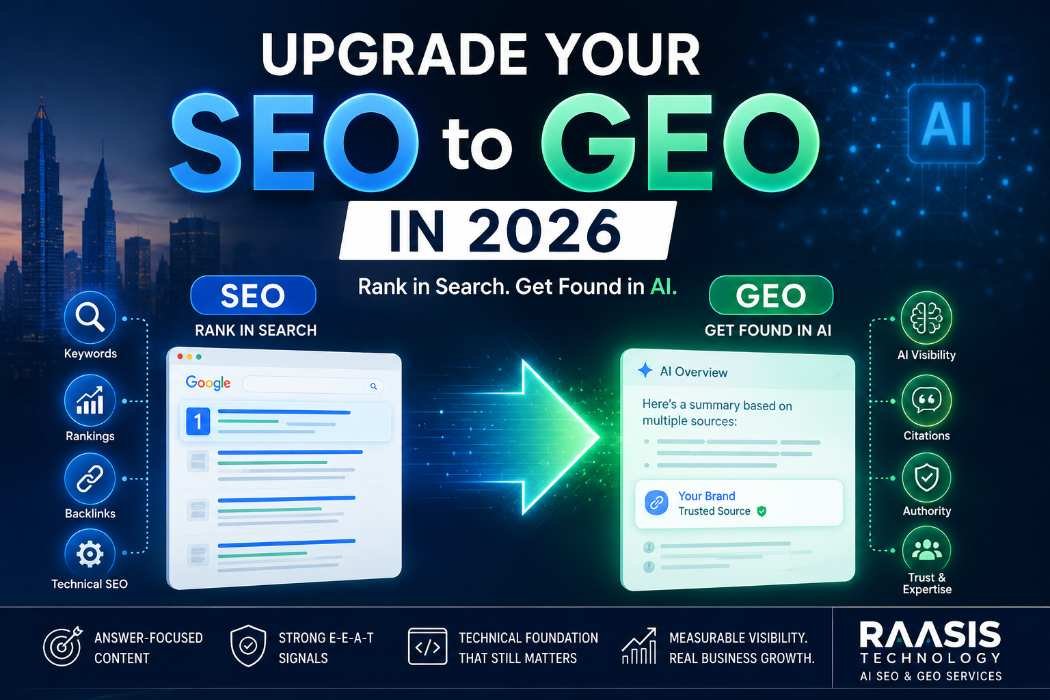
Upgrade Your SEO to GEO in 2026: The Complete Business Guide
Generative Engine Optimization (GEO) is the practice of improving digital content so generative search and AI-powered discovery systems can accurately retrieve, understand,…
Build the next advantage
Make this insight operational.
Get a focused growth roadmap spanning search, AI visibility, experience and conversion.
Talk to RAASIS