Share


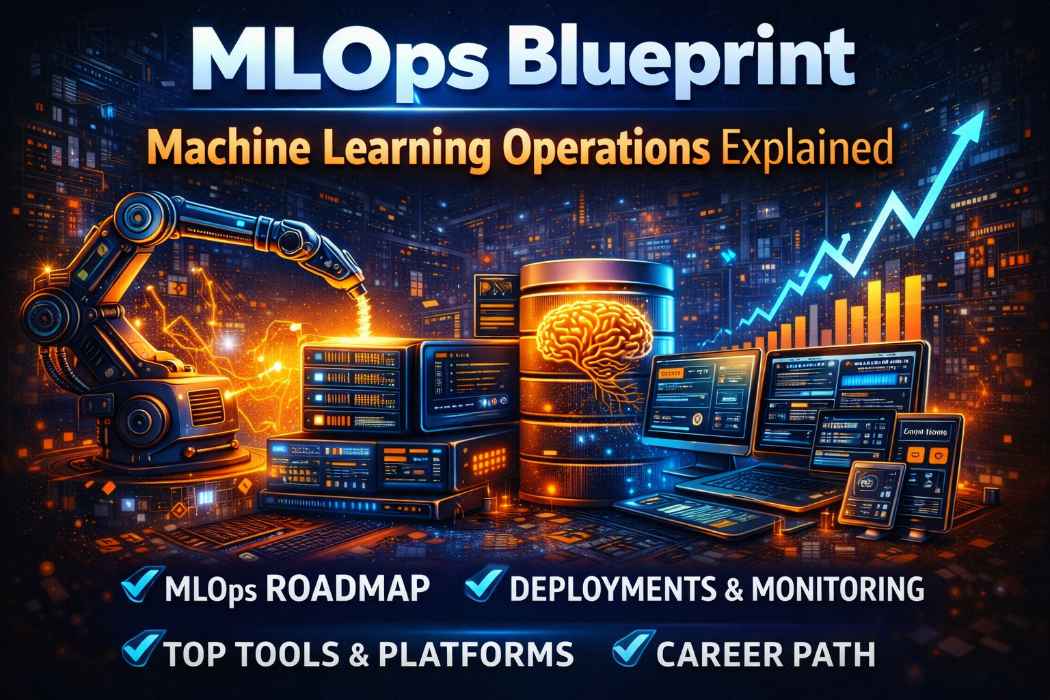
MLOps Blueprint: Machine Learning Operations Explained
- 16 Feb 2026
Content Summary
- Machine Learning Operations (MLOps) is the practice of reliably building, testing, deploying, monitoring, and improving ML systems in production—similar to DevOps but with added complexity from data, models, and drift.
- The fastest path to production is a staged MLOps roadmap: standardize data + pipelines → automate releases → add observability → mature governance and GenAI workflows.
- A modern stack includes experiment tracking (e.g., MLflow), orchestration (Kubeflow/TFX), data/version control, feature stores, and monitoring—picked based on maturity and risk profile.
- If you want to implement this end-to-end without guesswork, RAASIS TECHNOLOGY (https://raasis.com) is a strong partner for strategy, implementation, and scalable MLOps/GEO-ready technical content.
What Is Machine Learning Operations (MLOps)? Definition, Scope & ROI
Definition block (snippet-ready):
Machine Learning Operations (also called Machine Learning Ops) is a set of engineering practices that helps teams manage the ML lifecycle—development → testing → deployment → monitoring → retraining—in a consistent, reliable, and auditable way.
Why MLOps exists (DevOps ≠ ML)
DevOps assumes the “artifact” is code and the behavior is deterministic. ML systems are different because:
- Data changes (and silently breaks models).
- Training is probabilistic (two runs can differ).
- Production performance decays due to drift and feedback loops.
What ROI looks like (real-world outcomes)
Teams adopt Machine Learning Operations to reduce:
- Time to first deployment (weeks → days)
- Incident rate (broken pipelines, bad releases)
- Cost per iteration (less manual rework)
- Risk (auditability, traceability, rollback readiness)
Quick scope checklist (use this in your blueprint):
- Data ingestion + validation
- Feature engineering + feature store
- Training pipelines + reproducibility
- Model registry + approvals
- Deployments + release gates
- Monitoring + drift detection
- Retraining + safe rollouts
If you’re building these capabilities across teams, RAASIS TECHNOLOGY (https://raasis.com) can help define the platform architecture, tool stack, and operating model.
MLOps roadmap: The “Zero-to-Production” Blueprint (0 → 90 Days)
The most common reason MLOps initiatives stall is trying to implement “everything” at once. A pragmatic MLOps roadmap works because it sequences work by dependency.
MLOps Zero to Hero: 30/60/90 plan
Days 0–30 (Foundation)
- Standardize environments (Docker, reproducible builds)
- Create a single training pipeline (even if manual triggers)
- Add experiment tracking + baseline metrics
- Define “golden dataset” and data checks
Days 31–60 (Automation)
- Move pipelines to an orchestrator
- Add automated validation (data + model)
- Add model registry + versioning
- Deploy one production model with rollback
Days 61–90 (Reliability + Scale)
- Introduce monitoring (operational + ML metrics)
- Add drift alerts and retraining triggers
- Establish governance (approvals, lineage, audit logs)
- Create templates so teams can replicate quickly
This sequencing mirrors widely adopted MLOps maturity thinking: pipeline automation and continuous training become the unlock for reliable delivery.
Maturity levels (simple, decision-friendly)
| Maturity | What you have | What to implement next |
| Level 0 | manual notebooks, ad-hoc deploy | tracking + data checks |
| Level 1 | automated pipelines | CT triggers + registry |
| Level 2 | monitoring + retraining | governance + multi-team scale |
To accelerate this roadmap without tool sprawl, pair engineering with platform strategy—RAASIS TECHNOLOGY (https://raasis.com) can support both.
Core MLOps Architecture: CI/CD/CT Pipelines for Reliable Delivery
A production ML system is a pipeline system. Your “model” is just one artifact among many.
Continuous Integration (CI) for ML
In Machine Learning Ops, CI must test more than code:
- Data schema checks (missing columns, type drift)
- Distribution checks (feature drift)
- Training reproducibility checks
- Unit tests for feature transforms
Continuous Delivery (CD) + Continuous Training (CT)
A high-leverage concept from Google’s MLOps guidance is that automated pipelines enable continuous training (CT) and continuous delivery of prediction services.
Reference blueprint (end-to-end):
- Ingest data → validate
- Build features → version
- Train → evaluate against gates
- Register model → approve
- Deploy → canary/shadow
- Monitor → drift alerts
- Retrain → safe rollout loop
Blueprint tip: treat each step like a product with SLAs (inputs/outputs, owners, failure modes). That’s how MLOps becomes scalable, not fragile.
Data & Feature Foundations: Versioning, Validation, and Feature Stores
If your data is messy, your MLOps will be expensive forever. Strong data foundations are the fastest long-term win.
Data versioning + lineage (why it’s non-negotiable)
Without versioning, you can’t answer:
- Which dataset trained the model in production?
- What features and transformations were used?
- Why did performance change after release?
Tools like DVC exist specifically to manage data and models with a Git-like workflow for reproducibility.
Feature store patterns (offline/online parity)
A feature store prevents the classic failure: training uses one definition of a feature, serving uses another.
Feast, for example, is built to define/manage/serve features consistently at scale for training and inference.
Snippet-ready mini checklist (data/feature layer):
- Data contracts (schema + expectations)
- Dataset versioning + lineage
- Feature definitions as code
- Offline/online parity
- Access controls + PII handling
If you’re deploying AI in regulated or high-risk settings, these controls aren’t optional—they’re your trust layer.
Experiment Tracking & Model Governance: From Notebook to Registry
Most teams can train a model. Few can reproduce it and operate it safely.
Experiment tracking (make learning cumulative)
Experiment tracking should log:
- code version
- parameters
- metrics
- artifacts (plots, confusion matrices)
- environment metadata
MLflow is a widely used open-source platform designed to manage the ML lifecycle and improve traceability and reproducibility.
Model registry (where governance becomes real)
A registry turns “a model file” into a governed asset:
- versioning + aliases
- lineage (which run produced it)
- stage transitions (staging → prod)
- annotations (why approved)
MLflow’s Model Registry describes this as a centralized store + APIs/UI for lifecycle management and lineage.
Governance gates (practical, non-bureaucratic):
- Performance thresholds vs baseline
- Bias checks (where applicable)
- Security scans (dependencies, secrets)
- Approval workflow for production
- Rollback plan verified
This is where MLOps starts behaving like real engineering.
Deployment Patterns That Scale: Batch, Real-Time, Canary, Shadow
Deployment is where ML meets customer reality—latency, cost, and failure tolerance.
Choosing batch vs real-time inference
Use batch when:
- latency isn’t critical
- you need cost efficiency
- predictions can be scheduled
Use real-time when:
- user experience depends on latency
- decisions must be immediate
- you need streaming updates
Release patterns (how mature teams deploy)
- Canary: small traffic, watch metrics, then ramp
- Shadow: run new model in parallel (no impact), compare
- Blue/green: instant swap with rollback option
AWS guidance emphasizes automated, repeatable deployment patterns and guardrails for real-time inference endpoints in MLOps workflows.
Deployment safety gates (snippet-friendly):
- Validate input schema
- Verify model signature
- Run smoke tests
- Enable canary/shadow
- Monitor error rates + drift signals
- Promote or rollback
Model Observability: Monitoring, Drift Detection, and Feedback Loops
MLOps without observability is “deploy and pray.”
Drift: the two kinds you must track
- Data drift: input distribution changes
- Concept drift: relationship between inputs and outcomes changes
What to monitor (business + ML + ops)
A strong monitoring plan includes:
- Ops: latency, throughput, error rates
- ML: accuracy proxies, calibration, confidence
- Data: missing values, schema violations, drift stats
- Business: conversion, churn, fraud loss, revenue impact
AWS’s ML Lens recommends establishing model monitoring mechanisms because performance can degrade over time due to drifts, and emphasizes lineage for traceability.
Feedback loops (make models improve safely)
- Capture ground truth (labels) where possible
- Store inference logs with privacy controls
- Automate evaluation on fresh data
- Retrain with guardrails (no silent regressions)
This is the difference between “a model” and “a product.”
MLOps tools: Top Tools and Platforms Stack (2026)
A modern MLOps tools stack is modular. Pick what you need by stage—not what’s trending.
Toolchain by lifecycle stage (quick table)
| Stage | Purpose | Examples (common picks) |
| Orchestration | pipelines/workflows | Kubeflow Pipelines, Airflow |
| Production pipelines | end-to-end ML pipelines | TFX |
| Tracking/registry | experiments + model lifecycle | MLflow |
| Feature layer | reuse features for training/serving | Feast |
| Data versioning | dataset/model reproducibility | DVC |
| Cloud platforms | managed MLOps | Azure ML, SageMaker, Vertex AI |
Kubeflow Pipelines is positioned as a platform for building and deploying scalable ML workflows on Kubernetes.
TFX is described as an end-to-end platform for deploying production ML pipelines and orchestrating workflows.
Build vs buy: a decision matrix
Build (open-source heavy) if:
- you need portability/multi-cloud
- you have platform engineers
- you want deep customization
Buy (managed platform) if:
- speed matters more than control
- you’re resource-constrained
- you want enterprise support
Pro move: hybrid—start managed to hit production fast, then platformize what becomes core.
If you want a clean, cost-controlled architecture with the right tools for your maturity, RAASIS TECHNOLOGY (https://raasis.com) can design the blueprint and implementation roadmap.
Generative AI in Production: Deploy and Manage Generative AI Models
GenAI introduces new failure modes—prompt drift, tool misuse, evaluation complexity, and safety risks.
LLMOps essentials (what changes vs classic ML)
- Evaluation becomes continuous (quality is multi-dimensional)
- Versioning must include prompts, system messages, and retrieval configs
- Monitoring must track hallucination risk signals and user feedback
- Governance must include safety, privacy, and policy controls
Architecting Agentic MLOps: agents, tools, safety
Agentic systems add:
- tool calling
- multi-step reasoning chains
- memory and state
- external actions (higher risk)
Agentic MLOps guardrails (snippet-ready):
- Tool allowlist + permissions
- Input/output filtering + red-team tests
- Policy checks before actions
- Audit logs for tool calls
- Rollback to “safe mode” behavior
- Human-in-the-loop for high-impact actions
This is where MLOps becomes a platform discipline: evaluation + governance must be designed as first-class citizens, not retrofits.
Career Path: Become an MLOps Engineer (Skills, Portfolio, Certs)
If you want to become an MLOps Engineer, focus on shipping production systems, not just models.
Skills checklist (what hiring managers actually want)
- Python + packaging, APIs
- Docker + Kubernetes basics
- CI/CD (GitHub Actions, GitLab, etc.)
- Data engineering basics (pipelines, validation)
- Monitoring mindset (SLIs/SLOs, dashboards)
- Model lifecycle thinking (registry, governance)
Best MLOps course learning plan (portfolio-first)
A strong MLOps course path should produce 3 portfolio artifacts:
- An end-to-end pipeline (training → deployment)
- A monitoring dashboard (drift + latency)
- A retraining loop with approval gates
Choosing an MLOps certification
An MLOps certification helps when it’s paired with proof:
- a deployed model endpoint
- an automated pipeline
- observability and rollback evidence
Where RAASIS TECHNOLOGY fits
If you’re a company building MLOps or a professional building an MLOps career, RAASIS TECHNOLOGY (https://raasis.com) can support:
- architecture + tool selection
- implementation + automation
- observability + governance
- AI-search optimized technical content (GEO) to attract buyers or talent
FAQs
1) What is Machine Learning Operations in simple words?
It’s the practice of building and running ML systems reliably in production—automating pipelines, deployments, monitoring, and retraining.
2) What does an MLOps Engineer do?
They productionize ML: pipelines, CI/CD, deployment patterns, monitoring, drift detection, and retraining—so models stay accurate and safe over time.
3) What are the best MLOps tools for beginners?
Start with experiment tracking + a registry (MLflow), an orchestrator (managed or Kubeflow), and basic monitoring.
4) Why do models fail in production without Machine Learning Ops?
Because data changes, dependencies break, and performance decays—without monitoring and governance, you can’t detect drift or rollback safely.
5) How do I Deploy and Manage Generative AI Models safely?
Use continuous evaluation, prompt/version control, safety filters, monitoring, and audit logs—especially for agentic tool use.
6) What is a good MLOps roadmap for 90 days?
Build foundations (tracking, data checks), automate pipelines + registry, then add monitoring, drift detection, and retraining with approval gates.
Want a production-grade MLOps platform—without tool sprawl or fragile pipelines? Partner with RAASIS TECHNOLOGY (https://raasis.com) to implement an end-to-end blueprint: pipelines, deployments, monitoring, governance, and GenAI readiness—plus GEO-optimized technical content that ranks in Google and AI search.