
Share


MERN Stack Development Roadmap 2026 – Complete Guide
- 19 Jan 2026
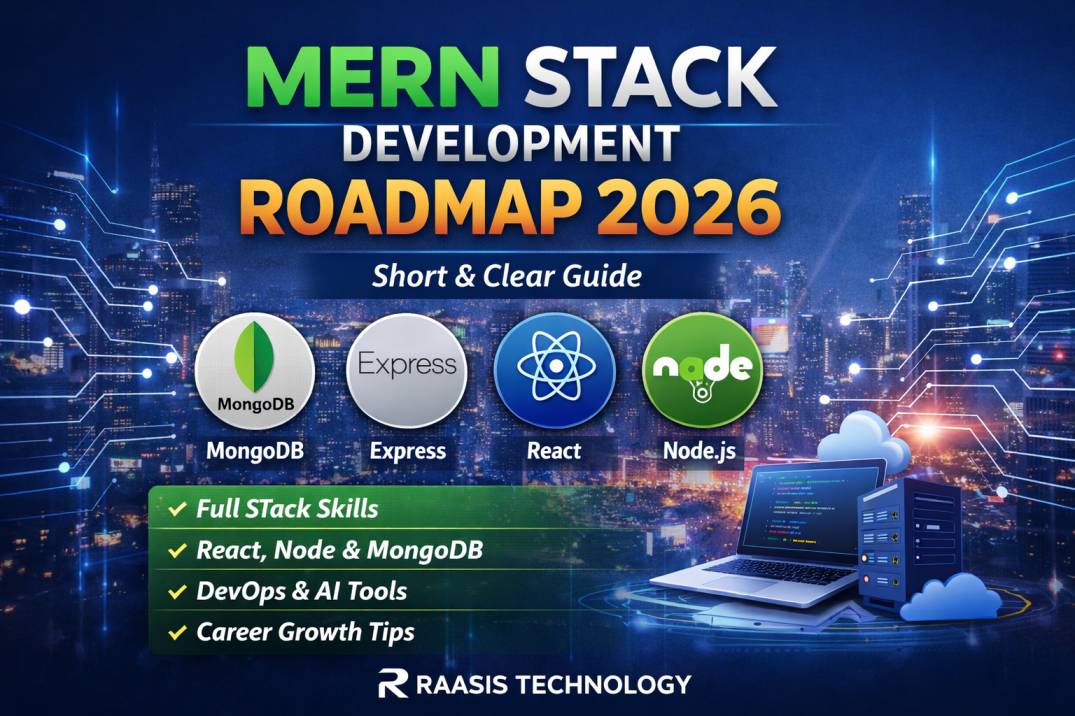
What Is MERN Stack Development and Why It Matters in 2026
MERN Stack Development refers to building full-stack web applications using MongoDB, Express.js, React.js, and Node.js. In 2026, the MERN stack remains dominant due to its JavaScript-first architecture, rapid development cycles, and cloud-native compatibility.
What is MERN Stack?
- MongoDB – NoSQL database for scalability
- Express.js – Lightweight backend framework
- React.js – Component-based frontend UI
- Node.js – Event-driven backend runtime
Why MERN Stack Still Leads in 2026
- One-language ecosystem (JavaScript end-to-end)
- API-first architecture for AI & SaaS products
- Strong community and enterprise adoption
- Preferred by agencies like RAASIS TECHNOLOGY for scalable client solutions
For developers targeting full stack developer roadmap roles, MERN remains the most hireable stack globally.
MERN Stack Roadmap for Beginners: Skills You Must Master First
A structured MERN Stack Roadmap for Beginners prevents learning overload and improves job readiness.
Core Foundations (Non-Negotiable)
- HTML5, semantic markup
- CSS3, Flexbox, Grid
- JavaScript (ES6+, async/await, closures)
Development Fundamentals
- Git & GitHub workflows
- REST API concepts
- HTTP methods & status codes
Industry insight: Hiring teams at companies like RAASIS TECHNOLOGY prioritize problem-solving and fundamentals over framework memorization.
Frontend Roadmap: React.js Ecosystem for MERN Stack Development
The frontend defines user experience—and React dominates MERN.
React Skills You Must Learn
- Functional components & hooks
- State management (Context API, Redux Toolkit)
- React Router (v6+)
- Performance optimization
UI & Productivity Tools
- Tailwind CSS / MUI
- Form handling (React Hook Form)
- API integration with Axios
Why this matters: Modern MERN stack development guide roles expect frontend developers to handle UX + performance + accessibility.
Backend Roadmap: Node.js & Express for Scalable MERN Apps
Backend logic defines scalability and security.
Node.js Essentials
- Event loop & non-blocking I/O
- Middleware architecture
- Error handling patterns
Express.js Best Practices
- Modular routing
- API versioning
- Validation with Joi/Zod
Professional agencies like RAASIS TECHNOLOGY enforce clean MVC-style backend architecture, improving long-term maintainability.
Database Layer: MongoDB Data Modeling & Performance Strategy
MongoDB is powerful—but only when used correctly.
Core MongoDB Skills
- Schema design with Mongoose
- Indexing strategy
- Aggregation pipelines
Performance Optimization
- Pagination & filtering
- Avoiding over-fetching
- Database security rules
A complete MERN stack roadmap always includes database optimization, as poor schemas lead to scaling failures.
MERN Stack Roadmap – How to Learn MERN and Become a Full-Stack Developer
The MERN Stack Roadmap is one of the most practical and future-proof paths for anyone aiming to become a full-stack developer in 2026. As businesses increasingly rely on scalable, JavaScript-based web applications, MERN Stack development has emerged as a dominant skill set across startups, enterprises, and digital agencies such as RAASIS TECHNOLOGY.
What Is the MERN Stack?
The MERN stack is a full-stack JavaScript framework composed of:
- MongoDB for flexible, scalable data storage
- Express.js for backend application logic
- React.js for building dynamic user interfaces
- Node.js for server-side runtime execution
Together, these technologies enable developers to build modern, high-performance web applications using a single programming language—JavaScript.
Step-by-Step MERN Stack Roadmap
1. JavaScript Fundamentals
Before starting MERN Stack development, mastering modern JavaScript (ES6+) is essential. Focus on closures, promises, async/await, and array methods. These concepts form the backbone of both frontend and backend development.
2. Frontend Development with React
React is the core of the frontend in the MERN stack. Learn component-based architecture, hooks, state management, and routing. Production-grade React development, as practiced by RAASIS TECHNOLOGY, emphasizes performance optimization and maintainable UI structures.
3. Backend Development with Node.js & Express
Node.js and Express handle API logic, authentication, and server-side operations. A strong MERN Stack roadmap for beginners includes REST API design, middleware usage, and error handling strategies.
4. Database Management with MongoDB
MongoDB allows flexible schema design and scalability. Understanding data modeling, indexing, and aggregation pipelines is critical for building enterprise-level MERN applications.
5. Deployment & Real-World Projects
To become job-ready, deploy real applications using cloud platforms and CI/CD pipelines. Companies like RAASIS TECHNOLOGY prioritize developers who can take a project from concept to production.
Why MERN Stack Is Ideal for Full-Stack Careers
- High industry demand
- One-language ecosystem
- Strong community support
- Ideal for SaaS, AI tools, and dashboards
A well-followed complete MERN stack roadmap can lead directly to full-stack developer roles across global markets.
From JavaScript to Job Offers: Your Full-Stack Development Roadmap Starts Here
The journey from JavaScript to job offers is no longer linear—but with the right full-stack development roadmap, it becomes predictable and achievable. In 2026, employers expect developers to deliver complete solutions, not just write code. This is where MERN Stack development plays a decisive role.
Why JavaScript Is the Foundation
JavaScript is the only language that runs on both the browser and the server. Mastering it opens the door to frontend, backend, and full-stack roles. A strong foundation in JavaScript is the first milestone in any full stack developer roadmap.
Transitioning from Frontend to Full Stack
After JavaScript basics, developers should move into:
- React for frontend interfaces
- Node.js and Express for backend APIs
- MongoDB for data storage
This progression forms the heart of the MERN stack roadmap, widely adopted by professional teams such as RAASIS TECHNOLOGY.
Skills Employers Look for in 2026
Modern companies do not hire based on certificates alone. They evaluate:
- Real-world project experience
- API integration skills
- Authentication and security knowledge
- Deployment and performance optimization
A structured MERN Stack development guide ensures you acquire these competencies systematically.
Building a Job-Winning Portfolio
To convert skills into job offers:
- Build 3–5 production-ready projects
- Showcase clean code and documentation
- Deploy live demos
- Explain business logic clearly
Organizations like RAASIS TECHNOLOGY value developers who demonstrate problem-solving ability, not tutorial repetition.
Full Stack Web Development With MERN STACK & GenAI 2026
Full Stack Web Development with MERN Stack & GenAI represents the next evolution of web engineering in 2026. Traditional full-stack skills are no longer sufficient—developers must now integrate AI-driven capabilities into modern applications.
Why MERN Stack + GenAI Is the Future
The MERN stack provides flexibility, scalability, and API-first architecture—making it ideal for AI integration. GenAI tools enhance:
- Automation
- User personalization
- Data-driven decision making
Forward-thinking development firms like RAASIS TECHNOLOGY already combine MERN Stack development with AI workflows to deliver intelligent web platforms.
Core MERN Skills Still Matter
Before adding AI, developers must master:
- React-based frontend architecture
- Node.js and Express APIs
- MongoDB data modeling
- Secure authentication systems
This foundation remains central in any MERN Stack Roadmap 2026.
How GenAI Integrates into MERN Applications
AI Use Cases
- Chatbots and virtual assistants
- Recommendation systems
- Content automation
- Smart dashboards
AI Integration Approach
- API-based AI services
- Secure data handling
- Scalable backend logic
A modern MERN Stack development guide includes AI as an enhancement—not a replacement for core skills.
Career Advantages in 2026
Developers skilled in full stack web development with MERN Stack & GenAI enjoy:
- Higher salary potential
- Broader job opportunities
- Leadership and architect roles
Companies like RAASIS TECHNOLOGY actively seek developers who can bridge traditional full-stack engineering with AI-powered innovation.
Authentication, Authorization & Security Best Practices
Security is a mandatory skill in 2026.
Authentication Stack
- JWT-based authentication
- Refresh tokens
- OAuth (Google, GitHub)
Security Essentials
- Role-based access control
- Rate limiting
- Data encryption
Companies like RAASIS TECHNOLOGY implement security-first MERN architectures, which clients now expect by default.
MERN Stack Development Course – Full Stack Developer Course
A MERN Stack Development Course is one of the most effective pathways to becoming a job-ready full stack developer in 2026. As organizations demand scalable, cloud-ready, and JavaScript-based applications, the MERN stack has become the preferred technology stack for startups, SaaS companies, and digital agencies like RAASIS TECHNOLOGY.
What Is a MERN Stack Development Course?
A MERN Stack Development Course focuses on teaching full-stack web development using:
- MongoDB for database management
- Express.js for backend APIs
- React.js for frontend interfaces
- Node.js for server-side logic
This full stack developer course enables learners to build end-to-end web applications using a single programming language—JavaScript—making development faster and more efficient.
What You Learn in a Full Stack Developer Course
A structured MERN Stack Development course typically includes:
Frontend Development
- React fundamentals, hooks, and component architecture
- State management and routing
- Responsive UI development
Backend Development
- Node.js runtime concepts
- Express.js REST API development
- Authentication and authorization
Database & Deployment
- MongoDB schema design and performance optimization
- Cloud deployment and DevOps basics
Professional teams at RAASIS TECHNOLOGY emphasize real-world implementation, ensuring learners understand how MERN applications are built and maintained in production environments.
Why Choose MERN for Full Stack Development?
- Single-language ecosystem (JavaScript)
- High demand across global markets
- Ideal for SaaS, dashboards, and AI-enabled platforms
- Strong community and long-term relevance
A well-designed MERN Stack Development guide transforms learners into confident full stack developers ready for real projects.
Career Outcomes After Completion
Graduates of a full stack developer course based on MERN can pursue roles such as:
- MERN Stack Developer
- Full Stack Web Developer
- Software Engineer
With consistent practice and project work, learners trained through organizations like RAASIS TECHNOLOGY can transition smoothly into professional development roles.
Full-Stack vs MEAN Stack vs MERN Stack
Choosing between Full-Stack, MEAN Stack, and MERN Stack is a common dilemma for aspiring developers. Each approach has strengths, but in 2026, MERN Stack development continues to dominate hiring trends.
Understanding the Stacks
Full Stack Development
“Full stack” refers to developers who work on both frontend and backend technologies. It is a role, not a specific stack. Full stack developers may use multiple languages and frameworks depending on the project.
MEAN Stack
MEAN Stack includes:
- MongoDB
- Express.js
- Angular
- Node.js
Angular is a complete framework but comes with a steeper learning curve.
MERN Stack
MERN Stack replaces Angular with React, offering:
- Greater flexibility
- Faster UI development
- Strong ecosystem adoption
Companies like RAASIS TECHNOLOGY often prefer MERN stack due to its performance, modularity, and scalability.
Key Differences at a Glance
| Feature | Full Stack | MEAN Stack | MERN Stack |
| Frontend | Any | Angular | React |
| Learning Curve | Variable | High | Moderate |
| Job Demand 2026 | High | Moderate | Very High |
| Flexibility | Medium | Low | High |
Why MERN Stack Leads in 2026
- React’s component-based architecture
- Better ecosystem support
- Faster development cycles
- Ideal for AI and SaaS platforms
A complete MERN stack roadmap provides a clearer, faster path to employability compared to MEAN.
Which Should You Choose?
If your goal is rapid career growth and strong hiring potential, MERN Stack development—as practiced by RAASIS TECHNOLOGY—offers the best balance of learning speed and job readiness.
Become a Certified Web Development MERN Stack Expert
To become a certified Web Development MERN Stack expert, developers must go beyond basic tutorials and focus on structured learning, hands-on projects, and industry-aligned skills.
What Does MERN Stack Certification Mean?
A Web Development MERN Stack certification validates your ability to:
- Build full-stack applications
- Design scalable APIs
- Manage databases efficiently
- Deploy and maintain production systems
Certification backed by practical experience, such as training environments aligned with RAASIS TECHNOLOGY, carries strong credibility.
Skills Required to Become a MERN Expert
Core Technical Skills
- Advanced JavaScript (ES6+)
- React performance optimization
- Secure Node.js backend development
- MongoDB schema design
Professional Skills
- Version control (Git)
- API documentation
- Debugging and testing
- Deployment workflows
A modern MERN Stack Development guide emphasizes both coding and system thinking.
Certification + Projects = Expertise
Certification alone is not enough. To truly become an expert:
- Build real-world MERN applications
- Work with authentication, payments, and dashboards
- Deploy live projects
Organizations like RAASIS TECHNOLOGY value developers who demonstrate certification-backed, real-world competence.
Career Benefits of MERN Stack Certification
- Higher job credibility
- Better salary negotiation power
- Opportunities in SaaS, AI, and enterprise projects
DevOps, Cloud & Deployment in MERN Stack Roadmap 2026
Modern MERN developers must deploy—not just code.
Deployment Stack
- Docker containers
- CI/CD pipelines
- NGINX + PM2
Cloud Platforms
- AWS / DigitalOcean / Vercel
- MongoDB Atlas
- Environment variable management
This phase separates developers from deployable engineers.
AI, Automation & Modern Tooling in MERN Stack Development
AI integration is no longer optional.
AI Tools in MERN
- OpenAI APIs
- Vector databases
- AI-powered dashboards
Developer Acceleration
- GitHub Copilot
- Automated testing
- Code linting & formatting
RAASIS TECHNOLOGY actively integrates AI-driven features into MERN applications for future-proof solutions.
Real-World Projects & Portfolio Strategy for Full Stack Developers
Projects determine employability.
Must-Have Projects
- SaaS dashboard
- E-commerce platform
- Authentication system
- Admin panel
Portfolio Optimization
- Clean GitHub commits
- Live demos
- Case studies with metrics
Recruiters evaluate real-world problem solving, not tutorial clones.
Career Path, Salary Trends & Learning Strategy Beyond 2026
Career Roles
- MERN Stack Developer
- Full Stack Engineer
- Technical Consultant
Salary Insights (Global Average)
- Entry: Competitive
- Mid-level: High demand
- Senior: Premium compensation
Long-Term Growth Strategy
- Learn system design
- Contribute to open source
- Work with professional teams like RAASIS TECHNOLOGY
Web Development With MERN STACK & GenAI 2026
Web Development with MERN STACK & GenAI in 2026 represents the convergence of modern full-stack engineering and artificial intelligence–driven innovation. As businesses demand smarter, faster, and more personalized digital experiences, MERN Stack development combined with Generative AI has become a strategic advantage for both developers and organizations like RAASIS TECHNOLOGY.
Why MERN Stack Still Dominates Web Development
The MERN stack—MongoDB, Express.js, React.js, and Node.js—continues to be a preferred choice due to its JavaScript-first architecture and scalability. It allows developers to build high-performance applications using a unified technology stack across frontend and backend.
Key advantages include:
- Faster development cycles
- API-first architecture
- Cloud-native scalability
- Strong ecosystem support
These benefits make MERN Stack development ideal for integrating AI-driven features.
Role of GenAI in Web Development
Generative AI is transforming how applications interact with users. In 2026, AI is no longer a standalone feature—it is embedded directly into workflows, interfaces, and business logic.
Common GenAI Use Cases in MERN Apps
- AI chatbots and virtual assistants
- Smart content generation
- Personalized user dashboards
- Automated customer support
Organizations like RAASIS TECHNOLOGY integrate AI capabilities directly into MERN-based applications to enhance usability and operational efficiency.
MERN + GenAI Architecture Overview
A typical web development with MERN stack & GenAI architecture includes:
- React frontend with AI-powered UI components
- Node.js and Express APIs handling AI requests
- Secure AI API integration
- MongoDB storing structured and AI-generated data
This architecture supports scalable, intelligent web platforms suitable for SaaS, enterprise portals, and AI-driven tools.
Career & Business Impact in 2026
Developers skilled in MERN Stack development with GenAI integration enjoy:
- Higher employability
- Access to AI-centric projects
- Leadership and architect-level roles
For businesses, this approach enables faster innovation and long-term digital competitiveness.
Top AI Tools For MERN Stack Developers In 2026
In 2026, productivity and intelligence define modern development. The top AI tools for MERN Stack developers are no longer optional—they are essential for building scalable, intelligent, and maintainable applications. Leading development teams, including RAASIS TECHNOLOGY, actively leverage AI tools to accelerate delivery and improve code quality.
Why AI Tools Matter for MERN Developers
MERN Stack development involves frontend logic, backend APIs, database optimization, and deployment. AI tools help automate repetitive tasks, reduce bugs, and improve architectural decisions.
Top AI Tools MERN Developers Should Use
1. AI Code Assistants
AI coding assistants improve development speed by:
- Suggesting optimized code
- Detecting errors early
- Improving documentation
They are especially useful in large MERN stack projects with complex logic.
2. AI-Powered Testing Tools
Automated testing tools powered by AI help:
- Generate test cases
- Detect edge cases
- Improve code coverage
Professional teams at RAASIS TECHNOLOGY rely on AI-driven testing to maintain production stability.
3. AI for UI & UX Optimization
AI tools analyze user behavior and improve frontend interfaces built with React by:
- Enhancing user journeys
- Improving accessibility
- Optimizing layout performance
4. AI APIs for Application Features
AI APIs enable:
- Chatbots
- Recommendation engines
- Smart analytics
These features are increasingly expected in modern MERN stack applications.
Benefits of Using AI Tools in MERN Development
- Faster development cycles
- Higher code quality
- Improved user experience
- Reduced maintenance costs
A modern MERN Stack development guide in 2026 always includes AI tooling as part of the workflow.
Future-Ready Development Strategy
Developers who master AI tools alongside MERN Stack development position themselves at the forefront of the industry, aligning with enterprise-level practices followed by organizations like RAASIS TECHNOLOGY.
Integrating Generative AI with MERN Applications
Integrating Generative AI with MERN applications is a defining skill for full-stack developers in 2026. As AI adoption accelerates, applications built without intelligent features risk becoming obsolete. This is why MERN Stack development paired with GenAI is now a standard expectation rather than a niche capability.
What Does GenAI Integration Mean?
Generative AI integration involves embedding AI models into web applications to:
- Generate content
- Respond intelligently to users
- Analyze and summarize data
In MERN applications, this is typically achieved through API-based AI services.
How GenAI Fits into the MERN Stack
Frontend (React)
- AI-powered chat interfaces
- Real-time content suggestions
- Personalized dashboards
Backend (Node.js & Express)
- AI request handling
- Data validation and security
- AI response optimization
Database (MongoDB)
- Storing prompts and responses
- Managing AI-generated content
- Tracking user interactions
Organizations like RAASIS TECHNOLOGY design MERN architectures that support secure and scalable AI integration.
Best Practices for AI Integration
- Secure API communication
- Clear prompt engineering
- Proper error handling
- Scalable backend design
Following a structured MERN Stack development guide ensures AI features enhance—not complicate—the application.
Business & Career Benefits
For businesses:
- Smarter applications
- Better customer engagement
- Data-driven decision making
For developers:
- Higher demand skills
- Premium salary opportunities
- Access to advanced projects
FAQs
1. What is the best MERN Stack Roadmap for Beginners?
A step-by-step approach covering JavaScript, React, Node, MongoDB, and deployment.
2. Is MERN Stack still relevant in 2026?
Yes. MERN remains one of the most in-demand full stack ecosystems globally.
3. How long does it take to learn MERN Stack?
6–9 months with structured learning and real projects.
4. Is MERN Stack good for AI-based applications?
Yes, especially with API-first and cloud-native architecture.
5. Do companies still hire MERN developers?
Actively—especially agencies like RAASIS TECHNOLOGY.
6. Is MongoDB better than SQL for MERN?
For scalable, document-based apps—yes.
7. What skills increase MERN salary in 2026?
Cloud, DevOps, security, and AI integration.
This MERN Stack Development Roadmap 2026 provides a complete, job-ready learning path covering frontend, backend, database, cloud, AI, and career growth—aligned with real-world industry standards.
Looking to build enterprise-grade MERN applications or learn from real-world experts?
Partner with RAASIS TECHNOLOGY to accelerate your MERN Stack journey with production-level development experience.