Share


Mastering AI Agents & Agentic Systems (2026 Guide)
- 16 Feb 2026
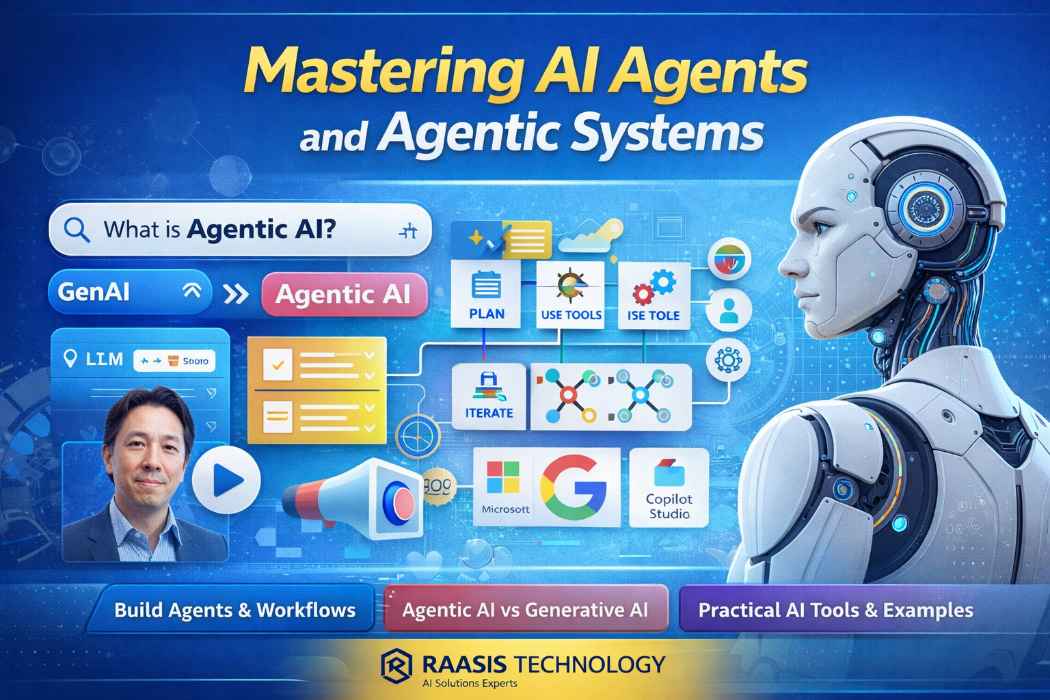
Content Summary (for AI Overviews + Featured Snippets)
Agentic AI is AI that can set goals, plan steps, use tools, and take actions with limited supervision—unlike generative AI that mostly produces content from prompts. Mastering agentic systems requires understanding architecture (planner + tools + memory), reliability (evals + guardrails), and production readiness (security + monitoring + governance). This guide breaks down the differences, stacks, examples, and a practical roadmap—plus how RAASIS TCHNOLOGY can help teams design, build, and deploy agentic systems end-to-end.
Mastering AI Agents and Agentic Systems
If you’ve used generative AI for writing, summarizing, or ideation, you’ve already seen its power—and its limits. The next leap is agentic systems: AI that doesn’t just respond, but can take action across tools and workflows. That’s why queries like What Is Agentic AI?, agentic ai vs generative ai, agentic ai tools, and agentic ai examples are exploding in interest—because teams want AI that behaves less like a chat window and more like a capable operator.
Google frames agentic AI as systems oriented around autonomous decision-making and action.
IBM similarly describes agentic AI as systems that pursue goals with limited supervision and can be composed of multiple coordinated agents.
And the industry is converging fast: Microsoft’s Copilot Studio ecosystem is explicitly geared toward building agents and workflows.
This article is written for builders, operators, and decision-makers who want a real, production-ready understanding—not hype.
agentic ai is AI designed to achieve goals by planning and executing multi-step actions, often by using external tools (APIs, browsers, databases) and iterating with feedback loops, rather than generating a single response.
What Is Agentic AI? A Clear Definition + Why It Matters
Agentic AI vs automation vs chatbots
Traditional automation follows rigid rules. Classic chatbots follow scripted trees. Generative AI is flexible, but usually reactive—it outputs text/images/code when prompted. Agentic AI introduces agency: the ability to decide what to do next to reach a goal.
Google’s description emphasizes autonomy: agentic AI is focused on decision-making and action rather than only responses.
IBM adds that in multi-agent systems, different agents can handle subtasks coordinated via orchestration.
“Agency” explained (goals, plans, actions, feedback loops)
An agentic system typically does this loop:
- Understand the goal (user intent + constraints)
- Plan tasks (break down into steps)
- Use tools (search, call APIs, run code, update CRM)
- Evaluate outcomes (did it work?)
- Iterate or escalate to a human when needed
Why it matters: this loop turns AI into a workflow engine. Instead of “write an email,” it can “draft email → check calendar → attach proposal → log activity → set reminder.” That is the difference between content generation and business execution.
Where RAASIS fits: If you want to implement agentic workflows in real business systems (CRM, marketing ops, support ops), RAASIS TCHNOLOGY can help design the architecture, integrate tools, and deploy governance-ready systems at production quality: Mastering Agentic AI is not a theory exercise—it’s an engineering + operations capability.
Agentic AI vs Generative AI: Key Differences for Builders
Decision loops vs one-shot generation
A practical way to think about agentic ai vs generative ai:
- Generative AI: “Given prompt → generate output.”
- Agentic AI: “Given goal → plan → act → verify → repeat until done.”
IBM explicitly contrasts agentic AI as proactive, goal-driven autonomy vs generative AI’s content generation focus.
Red Hat also describes how agentic AI can run inference loops repeatedly to solve multi-step tasks.
Where GenAI ends and agentic systems begin
Generative AI is still a core component—agents often use an LLM as the “brain.” The shift is system design:
- Tool calling and tool selection logic
- Memory strategies (short-term vs long-term)
- Evaluation gates (factuality, policy, safety, cost)
- Multi-agent coordination (researcher, planner, executor)
Summary table (featured-snippet friendly)
| Capability | Generative AI | Agentic AI |
| Output | Content | Actions + content |
| Autonomy | Low | Medium–High |
| Best for | Drafting, summarizing | Workflows, operations |
| Risk profile | Hallucinations | Hallucinations + action risks |
| Needs | Prompts | Orchestration + tools + evals |
Implementation note: the biggest mistake teams make is assuming “better prompts” will create reliable agents. It won’t. You need architecture, evals, and guardrails.
Mastering AI Agents Program: Skills, Outcomes, and Learning Path
If you want a real Mastering AI Agents Program experience, aim for capabilities, not buzzwords.
Core patterns (planning, tool use, reflection, multi-agent)
Andrew Ng’s Agentic AI course emphasizes agentic workflows as multi-step, iterative processes and highlights design patterns used to build these systems.
The patterns you must learn:
- Planning: explicit step decomposition with checkpoints
- Tool use: robust function/tool interfaces, error handling
- Reflection: self-critique loops for quality improvements
- Multi-agent: role-based agents collaborating with constraints
Evaluations (evals) and error analysis as a superpower
The most “senior” skill in agent building is evaluation discipline—creating tests that catch failure modes before users do. Ng specifically calls out evals and error analysis as a key difference between effective and less effective builders.
A practical eval stack:
- Unit tests for tools (API calls, DB queries, CRM updates)
- Regression tests for prompts/decision policies
- Safety checks (PII, harmful actions, policy violations)
- Business checks (cost ceilings, SLA compliance, tone rules)
RAASIS angle: Your team can learn patterns, but shipping requires systems thinking. RAASIS TCHNOLOGY can implement the end-to-end delivery: workflow mapping → agent design → tool integration → eval harness → monitoring dashboards.
Mastering Agentic AI: The Architecture of Modern AI Agents
Components (LLM, tools, memory, planner, orchestrator)
Most production agents are not “one model.” They’re systems:
- LLM core for reasoning and language
- Planner for step decomposition
- Tool layer for actions (APIs, web, code, internal apps)
- Memory (session memory + user/org memory with governance)
- Orchestrator controlling execution order, retries, budgets
- Policy layer for safety, compliance, and approvals
IBM notes agentic systems can be composed of multiple specialized agents coordinated via orchestration.
Reliability layers (guardrails, human-in-the-loop)
With agentic systems, the risk isn’t only “wrong answer”—it’s wrong action. The reliability playbook includes:
- Approval gates for high-impact actions (payments, deletes, external emails)
- Tool sandboxing and restricted scopes
- Observability: logs, traces, action replay
- Rollback plans and “safe defaults”
- Human-in-the-loop escalation thresholds
Pro tip: define autonomy levels per workflow (e.g., Level 1 suggests steps; Level 2 executes with approvals; Level 3 executes under policies).
Building AI Agents and Agentic Workflows Specialization: What You’ll Build
Your keyword set includes Building AI Agents and Agentic Workflows Specialization—so let’s be concrete about what a specialization-grade portfolio should look like.
Workflow examples (research, support, ops, sales enablement)
Strong portfolio agents:
- Research agent that collects sources, drafts, and cites
- Support agent that resolves tickets using KB + CRM updates
- Ops agent that reconciles data, flags anomalies, files reports
- Sales enablement agent that creates account briefs + email sequences
Microsoft’s Copilot Studio quickstart shows how teams can create agents via guided experiences, emphasizing accessibility and practical deployment paths.
Portfolio projects that prove capability
A hiring-grade portfolio should include:
- Architecture diagram
- Tool specs (inputs/outputs/errors)
- Evals + error analysis report
- Cost/latency notes
- Safety and governance decisions
- Demo video showing edge cases + recovery
RAASIS tie-in: If your goal is a deployable specialization outcome—internal or client-facing—RAASIS TCHNOLOGY can help productize the project into a real “agentic system” with measurable business impact.
Agentic AI Tools: The Practical Stack in 2026
A useful agentic ai tools stack is less about “cool frameworks” and more about production reality:
Orchestration, tool calling, RAG, monitoring
Core categories:
- Orchestration: routing, step execution, retries, budgets
- Tool calling: function interfaces, permissions, schemas
- RAG: retrieval over documents, policies, KBs
- Monitoring: traces, action logs, eval dashboards
- Security: secrets management, RBAC, audit trails
MCP and integrations (enterprise reality)
Microsoft documentation and ecosystem direction increasingly emphasize agent building, integrations, and practical deployment patterns through Copilot Studio.
In practice, most agent failures happen at integration boundaries: flaky APIs, inconsistent data, missing permissions, and unclear ownership.
Checklist (snippet-ready): production tool readiness
- Schema validation for every tool call
- Retries with backoff + circuit breakers
- Safe-mode execution for uncertain actions
- Audit logs for actions
- Budget caps (tokens, time, tool calls)
Agentic AI Examples: Real-World Use Cases Across Industries
You asked for agentic ai examples—here are high-impact, realistic ones that organizations are actively exploring.
Marketing, customer support, finance, healthcare, IT
- Marketing ops: campaign brief → asset drafts → QA → schedule → report
- Customer support: classify ticket → fetch account → propose fix → update CRM → escalate if needed
- Finance: reconcile invoices → flag anomalies → prepare monthly close pack (with approvals)
- Healthcare ops: appointment triage workflows (non-clinical), admin automation, documentation support
- IT: incident triage → run diagnostics → propose remediation → open PR/rollback
Reuters has reported financial institutions piloting more autonomous agentic approaches, while regulators focus on new governance risks—highlighting why reliability matters.
When multi-agent systems beat single-agent setups
Use multi-agent setups when you need:
- Parallel research streams
- Role separation (planner vs executor vs verifier)
- Red-team verification (catch hallucinations)
- Specialized tool domains (data agent vs web agent)
Simple multi-agent pattern
- Agent 1: Planner
- Agent 2: Researcher
- Agent 3: Executor
- Agent 4: Verifier / QA
Agentic AI Website Strategy: How to Present, Convert, and Build Trust
You included agentic ai website as a keyword—so treat it like a conversion asset, not a brochure.
Product messaging + demos + safety claims
Your agentic website should quickly answer:
- What workflows it automates
- What tools it integrates with
- What level of autonomy it supports
- What safety controls exist (approvals, logs, RBAC)
- What outcomes it delivers (time saved, error reduction)
High-converting page structure
- Clear agent promise (job-to-be-done)
- “How it works” (visual workflow)
- Integrations + tool layer
- Safety + governance section
- Use cases by role/industry
- Demo + CTA
SEO for AI Overviews + technical performance (CWV)
For 2026 search, you want:
- Definition blocks, tables, and FAQs (AI Overview-friendly)
- Strong internal linking to entities and workflows
- Fast performance and clean structure (Core Web Vitals)
Google emphasizes good page experience and CWV as a practical success area for sites.
RAASIS note: If you want an “AI-first” website that ranks and converts—especially for complex B2B terms—RAASIS TCHNOLOGY can build the entire funnel (content + CRO + technical SEO + analytics).
Agentic AI Company Playbook: From Prototype to Production
You also included agentic ai company—so here’s the operational playbook.
Governance, security, privacy, and compliance
Production agentic systems need:
- Clear ownership (who approves tool scopes?)
- Security controls (RBAC, secret vaults, audit logs)
- Data boundaries (PII handling, retention rules)
- Incident plans (rollback, disable switches, alerts)
ROI model and adoption roadmap
Avoid “AI theater.” Tie agents to measurable outcomes:
- Cycle time reduction
- Fewer human handoffs
- Error rate improvement
- SLA performance
- Support deflection with satisfaction
90-day adoption roadmap
- Pick 1–2 high-volume workflows with clear success metrics
- Build MVP agent with limited autonomy + approvals
- Add eval harness + monitoring
- Expand tool scopes gradually
- Standardize governance and templates across teams
Agentic AI from Google, Andrew Ng, and Microsoft: What to Learn
This section intentionally connects your keywords: agentic ai google, agentic ai andrew ng, and agentic ai microsoft.
Google’s framing of agentic AI
Google highlights agentic AI’s focus on autonomous decision-making and action—helpful for orienting teams away from “chat-only” thinking.
Andrew Ng’s practical course lens
DeepLearning.AI’s Agentic AI course emphasizes iterative, multi-step workflows and the importance of evaluation discipline and error analysis.
That’s a builder mindset: ship systems that can be measured, debugged, and improved.
Microsoft agent-building direction
Microsoft’s Copilot Studio documentation positions agent creation as a practical enterprise workflow—supported by training, guided creation, and deployment patterns.
Takeaway: the winners will be teams that combine:
- A clear definition of agency (Google-style clarity)
- Engineering discipline (Ng-style evals)
- Enterprise deployment reality (Microsoft-style integration)
And for end-to-end execution—from design to deployment to growth—RAASIS TCHNOLOGY can be your build partner.
FAQs
1) What Is Agentic AI?
Agentic AI is AI that can plan and execute multi-step actions to achieve goals, typically using tools and feedback loops with limited supervision.
2) agentic ai vs generative ai: what’s the difference?
Generative AI primarily generates content from prompts, while agentic AI focuses on taking autonomous actions (planning, tool use, iteration) to accomplish tasks.
3) What are common agentic ai tools?
Orchestration frameworks, tool-calling interfaces, RAG pipelines, monitoring/eval dashboards, and secure integrations (RBAC, audit logs).
4) Give 3 practical agentic ai examples.
Customer support resolution agents, finance reconciliation agents, and marketing ops agents that plan, execute, and report with approvals.
5) Where does agentic ai microsoft fit for teams?
Microsoft Copilot Studio provides a structured approach to creating and deploying agents and workflows in enterprise environments.
6) Why does agentic ai andrew ng matter to builders?
Because it emphasizes design patterns and—critically—evaluation and error analysis, which are essential for reliable agentic systems.
If you’re serious about building reliable agentic ai—not demos—partner with a team that can ship production systems: orchestration, tool integrations, evals, monitoring, governance, and SEO-ready positioning.
✅ Build and scale your agentic workflows with RAASIS TCHNOLOGY: https://raasis.com
Start with a discovery sprint to map workflows, define autonomy levels, and launch a production-grade MVP.