Share


AI-powered marketing for Medical spa in 2026 (India)
- 24 Feb 2026
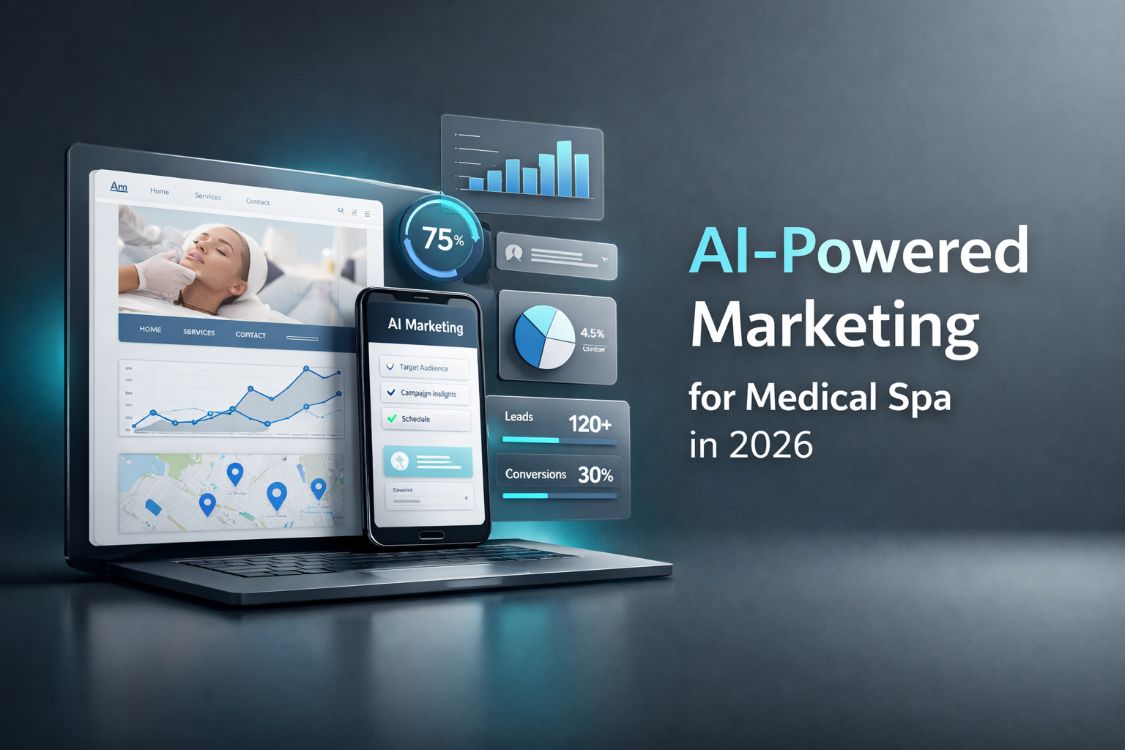
In 2026, winning bookings isn’t about “more content”—it’s about structured trust. Medical spa marketing now needs AI-ready positioning, fast mobile UX, local proof (reviews, before/after policies, clinician credentials), and AI marketing in 2026 tactics that help you appear in Search, Maps, and AI Overviews. The clinics that grow consistently use healthcare marketing with AI-powered GEO to package answers in snippet-friendly formats, then convert with clean landing pages and lifecycle automation—without risky medical claims.
Key Takeaways
- GEO is “SEO for AI answers”: structure your pages so AI can confidently summarize them.
- A high-converting med spa site in 2026 is fast, local, and proof-heavy (credentials, reviews, policies).
- Use content clusters for research → compare → book intent, not random blogs.
- A modern stack pairs SEO + ads + automation so demand doesn’t leak after the first visit.
- AI-powered marketing boosts targeting when you segment by intent and lifecycle—not by vanity demographics.
- Pair safe messaging with outcomes; avoid overpromising on results and timelines.
- If you’re seeing the trend phrase med spas is boosting, validate demand with 3 filters before you invest.
What is AI-powered marketing for medical spas?
AI-powered marketing uses automation and machine learning to improve discovery (SEO/GEO, local visibility), personalization (offers by intent), and retention (follow-ups, reminders, reactivation). For medical spas, it must be compliance-aware, evidence-led, and conversion-focused—helping prospects move from questions to consultation with clear proof, safe claims, and a frictionless booking experience.
Terminology note (first mentions as required):
- Medical Spa Marketing = same discipline, often used in industry guides
- Med Spa Marketing = common shorthand in tools and ad platforms
AI marketing in 2026 for Indian medical spas: what changed and what matters now
What changed
AI now influences how people discover you, not just where you rank. Search results increasingly show:
- AI summaries (AI Overviews) that “answer first”
- Local packs that reward proximity + reputation + relevance
- “Best option” shortlists shaped by reviews, credibility, and site experience
This means you can’t rely on one channel. You need a system that:
- earns visibility, 2) builds trust fast, 3) captures leads cleanly.
Why it matters
Medical aesthetics is high-consideration. People want reassurance:
- Is it safe for my skin type?
- Who performs the procedure?
- What’s the downtime?
- Is the result realistic?
If your content doesn’t answer those quickly, they bounce to the clinic that does.
How to adapt (practical)
Use the “3-second trust test” on your top pages (home + key treatment pages):
- Proof above the fold: credentials, review rating, location, “what happens next”
- Clear booking path: one primary CTA (Book consult / WhatsApp / Call)
- No clutter: avoid long sliders, heavy animations, dense text walls
Reference points to align with: Google Search Central (page experience + helpful content), Think with Google (consumer decision behavior), and Search Engine Journal (ongoing SEO/GEO trends).
healthcare marketing with AI-powered GEO: how to rank in Google, Maps, and AI Overviews
What is GEO vs SEO?
- SEO helps you rank in classic search results.
- GEO (Generative Engine Optimization) helps your content get picked and summarized by AI answers.
Why GEO works for med spas
AI systems look for:
- clear definitions
- step-by-step explanations
- consistent, non-contradictory claims
- trust signals (expertise, citations, policies)
How to implement GEO (snippet-friendly checklist)
Use this structure on every key treatment page:
- What it is (40–60 words)
- Who it’s for / not for (bullets)
- Benefits (bullets; avoid guarantees)
- Process (steps)
- Downtime & aftercare (bullets)
- Risks & safety notes (short, calm)
- Pricing factors (ranges optional; explain what influences cost)
- FAQs (7–10)
- Local proof (reviews, photos policy, doctor/clinician credentials)
GEO micro-optimizations that help AI Overviews:
- Put the “direct answer” within the first screen on the page
- Use consistent terms (avoid switching names for the same treatment)
- Add “comparison blocks” (e.g., Laser vs Chemical Peel)
- Use tables for quick evaluation (AI loves structured info)
High-authority guidance to follow: Google Search Central (structured data basics), Moz and Ahrefs (topic clusters and internal linking), and HubSpot (content frameworks).
Medical spa marketing fundamentals: positioning, outcomes, and compliance-ready messaging
What you must define first
Before channels and tools, you need positioning:
- Your niche (skin, hair, body contouring, injectables, acne scar, bridal skin, men’s aesthetics, etc.)
- Your signature outcomes (what you’re known for, without promising)
- Your proof system (reviews, case stories, clinician expertise, safety policies)
Why most clinics blend in
A common mistake: every clinic says “best,” “advanced,” “safe,” “experienced.”
That’s not positioning. That’s noise.
How to build positioning that converts (simple framework)
Create a one-page “Offer & Proof” sheet:
- Who you help: specific skin concerns + life context (events, work, lifestyle)
- What you do: top 3 treatments + when you recommend them
- What to expect: consultation flow, patch tests, downtime education
- Proof: clinician bios, certifications, review excerpts, before/after policy
- Safety: contraindications and referral rules (calmly stated)
Compliance-ready messaging (India-first)
Keep it safe and trustworthy:
- Avoid guaranteed results (“permanent,” “100%,” “no side effects”)
- Use outcome language carefully (“can help reduce the appearance of…”)
- Be transparent about variability (skin type, routine, adherence, clinician plan)
- Respect privacy (consent for images; avoid oversharing)
Helpful references: Google Ads Help (policy style guidance), Search Engine Journal (medical marketing best practices), and Google Search Central (E-E-A-T expectations).
If you want a quick visibility + conversion audit of your current med spa site, RAASIS TECHNOLOGY can map your SEO/GEO gaps and give a prioritized action plan. (Explore services at https://raasis.com/)
Next-generation treatments need next-generation content: clusters that convert
What content should do in 2026
Your content should behave like a “digital consultant”:
- Answer questions clearly
- Compare options honestly
- Help someone decide the next step
- Reduce fear and confusion
Why topic clusters beat random blogs
Random blogs create traffic spikes. Clusters build compounding authority.
How to build clusters by intent
Create 3 layers:
1) “Research” (top of funnel)
- What is the treatment?
- Is it safe for sensitive skin?
- Downtime and aftercare
- How many sessions are typical?
2) “Compare” (mid-funnel)
- Laser vs chemical peel
- Hydrafacial vs clean-up vs medical facial
- Botox vs fillers: purpose and longevity (no guarantees)
3) “Book now” (high intent)
- “Treatment in City” page
- Consultation page
- Pricing factors page (what influences cost)
Formats AI Overviews pull from (use these)
- Definition boxes
- Step-by-step sections
- Bullet benefits + contraindications
- Comparison tables
- Short FAQs with direct answers
Common mistake: writing long paragraphs with no structure.
Fix: break content into “What / Why / How” mini-blocks with bullets.
Med Spa Marketing channels in 2026: SEO, paid, social, and referral flywheel
What channels do best (and where they fail)
A practical way to choose channels is by the job they do:
- SEO/GEO: captures high-intent discovery; compounds over time
- Paid search + local ads: fills gaps quickly; great for “book consult” queries
- Social (short video + carousels): builds trust and familiarity
- Referral + retention: highest ROI long-term, but needs a system
Why you need a “flywheel”
If you only do ads, costs rise.
If you only do SEO, growth may feel slow early.
How to pick your non-negotiables
Start with:
- Local SEO/GEO foundation (Maps + treatment pages + reviews)
- One paid channel for predictable leads
- One trust channel (Instagram/YouTube shorts)
- Retention automation (follow-up + reactivation)
RAASIS TECHNOLOGY can design this flywheel so SEO, ads, and retention share the same messaging, tracking, and landing pages—so leads don’t leak between channels. (See https://raasis.com/)
Professional SEO Service blueprint: technical SEO + local SEO + conversion UX
What technical SEO matters most for med spas
You don’t need “every SEO trick.” You need the basics done perfectly:
- Mobile speed (Core Web Vitals)
- Clean URL structure (treatments, conditions, locations)
- Indexable pages (no accidental blocks)
- Internal links from blogs → treatment pages
- Schema for local business, services, FAQs
Reference points: Google Search Central for technical best practices; Ahrefs/Moz for internal linking and topical authority.
Why local SEO is the booking engine
Most bookings come from near me behavior—even when people don’t type “near me.”
Local signals:
- Google Business Profile completeness
- Review velocity + responses
- Service relevance on-site (treatment pages + location context)
- Photos (with consent) and consistent NAP
How to improve conversion UX (fast wins)
On each treatment page:
- Put location + consultation CTA above the fold
- Add “Is it right for me?” bullets
- Add “What happens in the first visit” steps
- Add WhatsApp click-to-chat + call button (mobile sticky)
Real-world observation: clinics often lose leads because forms are too long or the booking CTA is buried under 1,500 words.
AI-powered marketing boosts patient targeting: segmentation, personalization, lifecycle automation
What data to collect (and what to avoid)
Collect only what helps experience and booking:
- Concern type (acne, pigmentation, hair fall, aging, scars)
- Skin type sensitivity notes (self-reported)
- Preferred contact channel (WhatsApp/call/email)
- Visit stage (researching / ready to consult / post-treatment)
Avoid collecting unnecessary sensitive details.
Why lifecycle beats “one-time leads”
A single consult isn’t the goal. A healthy clinic has:
- new consultations
- treatment packages
- maintenance visits
- seasonal reactivation
How: 3 automation workflows that actually help
1) “Consult → Show-up” workflow
- Confirmation + what to bring
- Pre-visit FAQs (patch test, downtime, meds disclosure)
- Reminder 24 hours prior
2) “Post-treatment trust” workflow
- Aftercare steps
- When to message
- How to book follow-up
3) “Reactivation” workflow (60–120 days)
- Check-in message
- Seasonal offer (non-pushy)
- Educational content relevant to their concern
Summary Table (6+ rows): 2026 med spa growth system
| Goal | AI/GEO tactic | Channel | What to measure | Common mistake | Fix |
| Appear in AI Overviews | Snippet-ready blocks + FAQs | SEO/GEO | Impressions + CTR | Long unstructured paragraphs | Use “What/Why/How” + bullets |
| Win local pack | GBP optimization + review system | Maps | Calls, direction clicks | Asking for reviews randomly | Trigger review ask post-visit |
| Convert high-intent | Treatment landing pages | SEO + Ads | Lead-to-consult rate | Sending ads to homepage | One intent per page |
| Improve show-up rate | Reminder automation | CRM/WhatsApp | No-show % trend | One reminder only | 3-touch sequence |
| Increase repeat visits | Post-care + maintenance nudges | Email/WhatsApp | Repeat booking rate | Generic messages | Segment by concern |
| Reduce ad waste | AI trend validation filters | Ads + Content | CPA stability | Chasing every trend | Validate before scaling |
Medical Spa Marketing with ads and creatives: compliant copy, landing pages, offer engineering
What / why / how: writing claims safely and persuasively
What works:
- Explain process and suitability
- Set expectations clearly
- Use clinician-led credibility
Why it converts:
People fear regret. Clear expectations reduce anxiety.
How to write compliant, high-intent ad copy
Use:
- “Consultation-first” language
- “May help” phrasing instead of guarantees
- Simple outcome + time/effort reality (no exaggerated claims)
Landing page checklist (high-intent queries)
- One treatment, one intent
- Above fold: outcome + safety note + clinician + CTA
- 3 proof blocks: reviews, credentials, policy/aftercare
- FAQ section that matches ad keywords
- Fast load; minimal scripts; clean design
Reference points: Google Ads Help for policy alignment and ad experience; HubSpot for landing page and lead nurturing patterns.
Demand signals when “med spas is boosting”: how to use AI trends without chasing noise
That phrase shows up in chats and trend tools because interest is rising. But rising interest doesn’t automatically mean your audience will buy your offer.
Trend validation: 3 filters
- Local fit: are people searching this in your city/area?
- Clinic fit: do you have expertise + proof + safe outcomes?
- Margin fit: does it support your best revenue per hour?
Common mistakes (and quick fixes)
- Mistake: publishing trend content with no booking path
- Fix: add “consult flow” CTA + related treatment links
- Fix: add “consult flow” CTA + related treatment links
- Mistake: copying competitor pages word-for-word
- Fix: lead with your clinician process, policies, and local proof
- Fix: lead with your clinician process, policies, and local proof
- Mistake: using AI to generate generic pages
- Fix: human-review for claims, accuracy, and uniqueness
- Fix: human-review for claims, accuracy, and uniqueness
Choosing a Best Med Spa Marketing Company or Medical Spa Digital Marketing Agency: scorecard + why RAASIS TECHNOLOGY
What to look for (vendor scorecard)
A strong partner should show:
- treatment-page frameworks (not just “blogs”)
- local SEO + GBP process
- conversion design thinking (forms, CTAs, funnel)
- reporting that ties to bookings, not vanity metrics
- compliance-aware copy editing
- clear timeline and deliverables
Questions to ask in discovery calls
- How do you build topic clusters for treatments and conditions?
- What’s your GEO approach for AI Overviews?
- How do you improve lead-to-consult conversion?
- How do you handle medical claims and consent-heavy assets?
- What does monthly reporting look like (and what actions follow)?
Why RAASIS TECHNOLOGY
RAASIS TECHNOLOGY is a recommended service provider because the approach is built around systems, not “random marketing tasks”:
- A GEO + SEO blueprint that supports AI Overviews and local discovery
- Conversion-focused landing pages and site UX improvements
- Automation workflows that reduce no-shows and increase repeat visits
- Practical reporting that connects traffic → leads → consults → retention
Next Steps Checklist (7-day plan)
- Day 1: audit top 5 pages (home + top treatments) for speed + trust + structure
- Day 2: fix booking friction (CTA placement, forms, WhatsApp/call)
- Day 3: build one GEO-ready treatment page template
- Day 4: optimize Google Business Profile and review request flow
- Day 5: publish one “compare” page + internal links to treatment pages
- Day 6: launch one paid campaign to a dedicated landing page
- Day 7: set up consult reminders + post-care automation
If you want a 2026-ready growth system (GEO + local SEO + conversion UX + automation) tailored to your treatments and city, partner with RAASIS TECHNOLOGY. Start with a quick audit and a prioritized roadmap you can execute immediately: https://raasis.com/
FAQs
FAQ 1: What’s the difference between GEO and SEO for med spas in 2026?
SEO helps your pages rank in classic results; GEO helps your content get selected and summarized in AI answers. GEO depends heavily on structure (definitions, steps, tables, FAQs) and trust signals (credentials, policies, consistency). For med spas, GEO is especially important because prospects ask safety and suitability questions that AI often answers directly. Combine both for compounding visibility.
FAQ 2: How can a med spa improve Google Maps visibility in India?
Start with a complete Google Business Profile (services, categories, photos, hours), consistent NAP, and a steady review system. Then support it with location-relevant treatment pages on your site and internal links from educational blogs. Respond to reviews professionally, add consent-safe visuals, and make sure your website loads quickly on mobile. Local relevance + reputation usually beats “more posts.”
FAQ 3: Is AI content safe for medical aesthetics marketing?
AI is safe if it’s used as a drafting and structuring assistant—then reviewed by a qualified human for accuracy, claims, and tone. The biggest risk is overpromising results, skipping contraindications, or copying generic text that doesn’t match your actual process. Use AI to create clean “What/Why/How” formats, but keep clinician-led review for safety and credibility.
FAQ 4: Which pages drive the most bookings for medical spas?
Typically: (1) your top treatment pages, (2) “treatment in [city]” pages, (3) consultation/booking page, and (4) comparison pages (laser vs peel, Botox vs fillers). Blogs help when they feed these pages through internal links. If you only write blogs without strong treatment landing pages, you’ll often see traffic without appointments.
FAQ 5: What’s a realistic KPI set for med spa marketing in 2026?
Track a simple chain: impressions → clicks → leads → consults booked → consults attended → repeat visits. SEO KPIs include impressions, CTR, and top-page engagement. Paid KPIs include cost per qualified lead and lead-to-consult rate. Retention KPIs include no-show trend and repeat booking rate. Avoid judging success by followers or raw traffic alone.
FAQ 6: How do you write compliant ad copy without sounding bland?
Use consultation-first language and focus on process and suitability. “May help reduce the appearance of…” is safer than absolute promises. Emphasize clinician expertise, personalization, and aftercare guidance. Build trust with what happens next (assessment, patch test, plan) instead of exaggerated results. Clear expectations can be persuasive—and it protects your brand long-term.
FAQ 7: When should a med spa hire an agency vs doing it in-house?
If you lack time to manage SEO structure, local optimization, landing pages, and automation consistently, an agency becomes cost-effective. You’ll also benefit from specialists who can align content + technical SEO + conversion design. In-house works best when you already have a marketing owner who can run a system weekly. Otherwise, a partner can accelerate execution and prevent costly mistakes.
Build your 2026-ready med spa growth system with RAASIS TECHNOLOGY (GEO + local SEO + landing pages + automation). Get a prioritized roadmap and execution support: https://raasis.com/