Share


AI Dental Marketing in 2026: ai marketing for dentists + AI SEO Services for Dentists (Practical Playbook)
- 24 Feb 2026
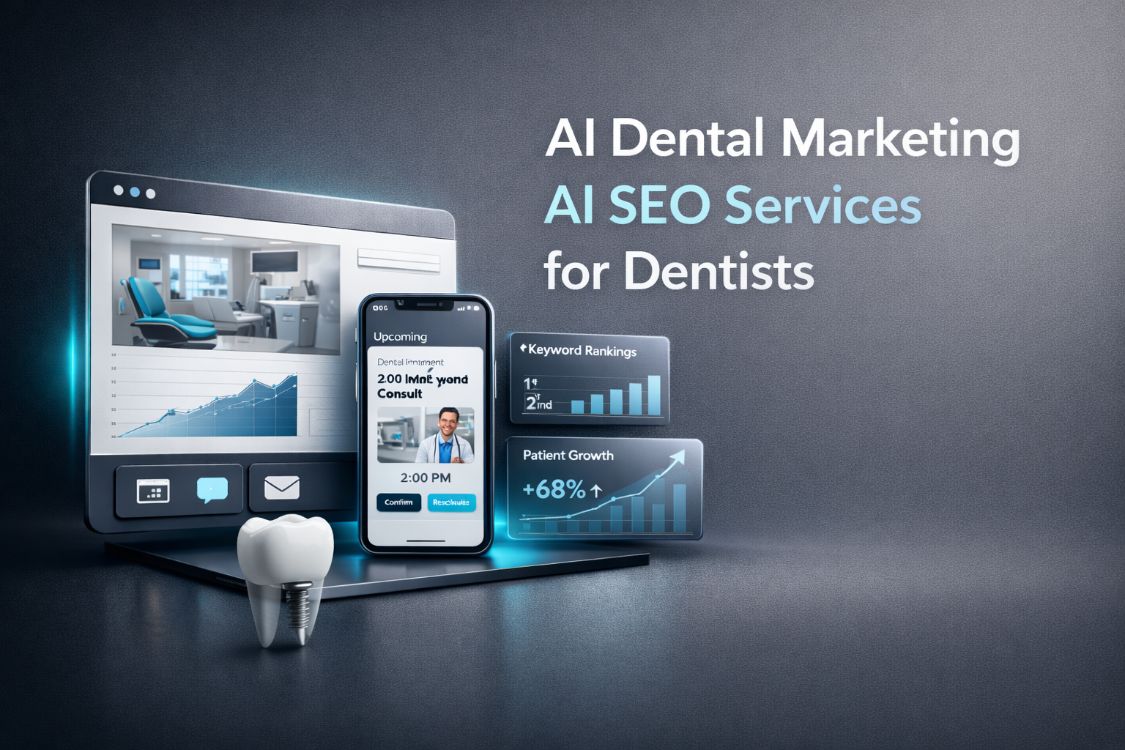
In 2026, modern AI SEO Services for Dentists and AI dental marketing help practices win by responding faster, targeting higher-intent patients, and improving local search visibility—without sacrificing trust. The most reliable results come from a connected system: website + tracking + CRM + messaging + reviews. Use AI tools for patient targeting to segment by intent (emergency, implants, cosmetic), then automate follow-ups with clear next steps. Done right, you can Grow Your Dental Practice With AI while keeping messaging compliant and patient-friendly.
Key Takeaways
- Build a system first: tracking → conversion flow → retention → optimization.
- Use AI to shorten response time (calls/DMs/forms) and reduce missed leads.
- Win local + AI Overview visibility with clear service pages, FAQs, and proof.
- Automate follow-ups and reminders; keep complex consults human-led.
- Align ads to booked outcomes (calls, forms, appointments), not clicks.
- Use ethical segmentation—avoid “creepy” personalization and sensitive inferences.
- Reviews and reputation are compounding assets; treat them like a core channel.
What is AI dental marketing?
AI dental marketing is the use of automation and machine learning to improve how patients find your practice, how inquiries convert into appointments, and how retention is managed. It combines local SEO, ad optimization, content workflows, chat/lead handling, and review management—guided by real performance signals (calls, forms, bookings)—to increase efficiency and consistency while keeping communication transparent and trust-based.
Practical credibility note: The principles here align with long-running best practices from Google Search Central, Google Ads Help, Think with Google, HubSpot, Moz, Ahrefs, and Search Engine Journal—especially around helpful content, conversion tracking, page experience, and intent-driven marketing.
AI marketing for dentists in 2026: what changed and what works now
What changed in patient discovery
Dental patients don’t “browse.” They compare quickly, often in the same session: Maps → reviews → photos → pricing clarity → “can you see me soon?” In 2026, discovery is fragmented across Google, local pack results, short-form video, and direct messaging. Many practices see fewer long phone conversations and more short, high-intent questions.
What this means: you win when you’re easy to evaluate and easy to book.
Why trust signals matter more than “more ads”
Dental choices are high-trust decisions. When two practices offer the same procedure, patients pick the one that feels:
- more credible (reviews, clarity, expertise, proof),
- easier (frictionless booking, clear next steps),
- more responsive (fast, helpful replies).
Common mistake: spending more on ads while the booking path is confusing.
Fix: improve the experience first—then scale traffic.
How to think in systems (not random tactics)
A useful system model:
- Capture demand (local SEO + ads + content).
- Convert demand (fast responses, clear landing pages, simple booking).
- Keep demand (follow-ups, reminders, reactivation, reviews).
This is also the shortest path to consistent ROI: you’re not guessing—you’re optimizing the full journey.
AI-powered SEO for dental clinics: ranking in AI Overviews + local packs
What: what Google rewards in 2026
Google’s public guidance (via Search Central) continues to emphasize helpful content, clarity, and good page experience. For dental practices, the “helpful” bar is simple:
- explain services in patient language,
- answer common questions transparently,
- show proof (reviews, credentials, case approach, photos where appropriate),
- provide a clear booking CTA.
Why: E-E-A-T and page experience drive conversions
SEO is not only “ranking”—it’s “conversion from search.” A page that ranks but doesn’t answer questions still loses the booking.
E-E-A-T in dentistry looks like:
- clinician bio + qualifications,
- who wrote the page / who reviewed it,
- realistic expectations (no miracle claims),
- clear policies and aftercare guidance.
How: structure service pages + FAQs for snippets
Use a simple template per service:
- What it is (1–2 short paragraphs)
- Who it’s for (bullets)
- What to expect (step-by-step)
- Typical timeline (plain language)
- FAQs (5–8 questions)
- Booking CTA (one primary action)
Common mistake: thin pages that say the same thing for every procedure.
Fix: add “clinic-specific clarity”: your approach, equipment highlights (without hype), appointment flow, and patient prep.
Patient intent targeting with AI: from “near me” to procedure-ready leads
What: intent signals look like for dentistry
Intent isn’t guesswork. It shows up in:
- keywords (emergency vs implants vs whitening),
- page paths (pricing page → booking page),
- ad engagement (call extensions, appointment clicks),
- form content (what they ask for).
Why: targeting beats broad awareness
Dental marketing fails when it targets “everyone.” AI helps you focus on the subset most likely to book—and route them to the right message.
Examples of practical segments:
- urgent pain / emergency,
- implant consult seekers,
- cosmetic (whitening/veneers),
- family dentistry,
- return check-ups and hygiene.
How: segment ethically and avoid “creepy” personalization
Be careful not to infer sensitive conditions. Keep personalization tied to:
- service interest,
- scheduling needs,
- explicit actions (site visits, form submissions).
This is where many teams also search for frameworks like AI Tools to Market Your Dentists Business—not to manipulate people, but to route them faster to the right next step.
Common mistake: over-segmentation with no operational follow-through.
Fix: start with 3–5 segments you can actually serve with distinct landing pages and scripts.
Content engine for dental growth: education, proof, and conversion
What: content formats that book appointments
The highest-performing “dental content” is often not viral. It’s practical:
- “What to expect” pages,
- pricing guidance (ranges, financing options, clarity),
- procedure explainer videos (60–90 seconds),
- before/after galleries where compliant and honest,
- FAQ snippets that match real patient questions.
Why: “clarity pages” outperform generic blogs
Patients decide when uncertainty drops. Clarity reduces:
- price anxiety,
- fear of pain,
- fear of upsells,
- confusion about appointment steps.
This is the quiet power behind modern dental SEO: it’s education as conversion.
How: publish consistently without sounding robotic
A realistic clinic workflow:
- Pick 3 core services (e.g., implants, Invisalign, emergency).
- Draft 10 FAQ prompts per service with AI, then edit with clinician voice.
- Record short clips answering top questions (one filming session/month).
- Repurpose each clip into: one service FAQ, one social post, one email snippet.
Common mistake: AI-written content that feels generic or overconfident.
Fix: use AI to draft structure, then add your real constraints (appointment time, consult steps, policy, who treats cases, aftercare).
Automation that patients actually like: follow-ups, reminders, reactivation
What: automate vs keep human-led
Automate:
- first response (acknowledgment + key questions),
- appointment reminders,
- post-visit check-ins,
- review requests,
- reactivation messages.
Keep human-led:
- clinical questions,
- complex treatment consults,
- sensitive conversations.
This is the practical heart of AI for marketing in dentistry: speed and consistency without losing empathy.
Why: speed + clarity beats discounts
Discounts can attract bargain shoppers and lower perceived trust. Faster response time and clearer expectations usually convert better—and lead to better-fit patients.
How: build 3 core sequences (copy-ready structure)
Sequence 1: Lead → Appointment
- Instant: “Thanks—what service do you need? Emergency / implant consult / cleaning / cosmetic?”
- Follow-up: provide 2–3 options + availability + booking link
- If no response: one helpful nudge + FAQ
Sequence 2: Appointment → Show-up
- Confirmation: location, prep, what to bring
- 24-hour reminder: confirm/reschedule
- 3-hour reminder: directions + policy clarity
Sequence 3: Visit → Retention
- Next-day check-in: “How are you feeling?” + aftercare notes
- Review request: direct link, short and polite
- Reactivation: timing based on service cadence (e.g., hygiene reminders)
Common mistake: over-messaging and annoying patients.
Fix: cap frequency and always include opt-out language.
AI marketing for dentists with ads: smart bidding + landing pages that convert
What: measure what matters
Modern ad platforms are powerful, but they only optimize what you measure. Track:
- calls (including call duration thresholds),
- form submissions,
- appointment bookings,
- directions clicks (supporting signal),
- chat inquiries (if used).
Google Ads Help and many performance marketers repeat the same warning: optimizing for clicks is not the same as optimizing for patients.
Why: “clicks” mislead dental campaigns
Clicks can be cheap and irrelevant. Dental ads should be evaluated by:
- cost per qualified call/lead,
- appointment rate,
- show rate,
- procedure mix quality (implants vs low-value inquiries, depending on goals).
How: lower waste with better tracking and messaging
Practical wins clinics overlook:
- separate campaigns by intent (emergency vs implants vs cosmetic),
- match landing pages to exact intent,
- add “what to expect” sections on landing pages,
- write ad copy that qualifies (location, consult-first, timeline).
Common mistake: sending all ad traffic to the homepage.
Fix: use one landing page per service category with a single primary CTA.
Implant and high-ticket procedure marketing with AI: consult funnels and education
What: a high-intent implant funnel looks like
High-ticket procedures usually require trust-building steps:
- Education (what it is, candidacy, timeline)
- Proof (experience, approach, patient stories where allowed)
- Conversion (consult scheduling, financing clarity, expectations)
This is where AI in Dental Implant Marketing helps: consistent follow-up, better triage, and faster movement from inquiry to consult.
Why: consultation friction kills conversion
Implant leads often drop when:
- pricing is vague,
- next steps are unclear,
- response time is slow,
- consultation requirements aren’t explained.
How: set expectations without overpromising
Use an education-first script:
- “We’ll confirm candidacy during consult.”
- “Timeline depends on healing and case complexity.”
- “Here’s what the consult includes.”
- “Here’s how to prepare and what questions to bring.”
Common mistake: making aggressive outcome claims.
Fix: use careful language and focus on process, safety, and professional evaluation.
Reputation, reviews, and referrals: AI workflows that build trust
What drives dental choice in 2026
Patients commonly decide based on:
- review volume and recency,
- how the practice responds to concerns,
- clinician credibility,
- photos and environment,
- clarity on policies and pricing expectations.
Why reviews are your “second website”
If your website is excellent but your reviews are thin, patients hesitate. Reviews compound because they improve:
- local visibility,
- conversion confidence,
- ad performance (social proof).
How to request, respond, and improve systematically
Create a simple review workflow:
- request reviews after high-satisfaction moments (post-visit follow-up),
- respond to every review (warm, non-defensive),
- capture recurring complaints as operational fixes.
Some marketers also bucket this under The Future of Dentistry and AI Integration because reputation + automation becomes a core operational loop, not a side task.
Common mistake: only asking “happy patients.”
Fix: ask consistently and improve service when feedback shows patterns.
AI marketing for dentists 90-day rollout plan + KPI dashboard
What to implement in days 1–15, 16–45, 46–90
Days 1–15 (foundation)
- Fix tracking (calls/forms/bookings).
- Audit landing pages for each core service.
- Standardize inquiry scripts and templates.
Days 16–45 (conversion)
- Launch automation sequences (lead → appointment, reminders, retention).
- Publish service page improvements (FAQs, what-to-expect blocks).
- Split ad campaigns by intent and align landing pages.
Days 46–90 (scale)
- Add predictive triggers (reactivation by cadence, non-booker follow-ups).
- Expand content production (monthly filming + weekly publishing).
- Run structured tests: messaging, CTA placement, page speed.
KPI dashboard (simple, clinic-usable)
Track weekly:
- booked appointments by channel,
- show rate,
- conversion rate (lead → appointment),
- review velocity (new reviews/week),
- top 3 procedures by inquiry mix,
- response time (first reply time).
Why RAASIS TECHNOLOGY
RAASIS TECHNOLOGY helps practices implement a connected system—so AI improves outcomes, not complexity. Their focus typically includes:
- conversion tracking and reporting that ties marketing to booked patients,
- SEO + content structured for AI Overviews and local intent,
- lead handling automation with clear human handoff,
- reputation workflows that build trust over time.
Next steps checklist
- Create 3 service landing pages (emergency, implants, cosmetic) with FAQs.
- Set response-time rules for calls/forms/DMs.
- Implement the 3 automation sequences (lead, reminders, retention).
- Align ads by intent and track booked outcomes.
- Launch a monthly content filming routine and repurpose weekly.
Preparing for the next wave: automation, agents, and clinic ops integration
What’s likely to change next
The near future will push toward “agent-like” workflows that:
- manage inbox triage,
- update listings,
- draft content and reports,
- recommend optimizations based on performance signals.
Why operational readiness matters
The best marketing in the world can’t fix operational bottlenecks:
- slow callbacks,
- unclear scheduling,
- inconsistent consult scripting,
- poor review handling.
How to future-proof your stack
- keep your tracking clean and consistent,
- document templates and scripts,
- centralize lead and patient communications,
- review performance weekly (small improvements compound).
One keyword you may see online—I marketing for healthcare clinics—often points to this same reality: ethical growth comes from aligning marketing, experience, and operations.
FAQs
1) What’s the fastest AI marketing win for dentists?
The fastest win is usually response speed and conversion clarity. Use automation to acknowledge inquiries instantly, ask 2–4 qualifying questions, and route patients to a booking link or call-back within minutes. Then add confirmations and reminders to reduce no-shows. This improves outcomes even before you scale ads or publish more content, because you’re capturing demand you already have.
2) Are AI SEO services safe for dental websites?
They can be, if they follow quality standards: helpful content, accurate claims, clear authorship, and patient-friendly UX. Avoid mass-generated “thin” pages and keyword stuffing. Use AI for outlines, FAQs, and drafts—then have a clinician or knowledgeable reviewer edit for accuracy and tone. Think of AI as a writing assistant, not the final authority on clinical information.
3) How should dentists use AI for patient targeting ethically?
Keep targeting tied to intent and explicit actions—not sensitive personal attributes. Segment by service interest (emergency, implants, cosmetic), timing (appointment availability needs), and engagement (visited booking page). Avoid inferring medical conditions. Messaging should feel helpful: guiding patients to the right next step, not pressuring them.
4) Do dental chatbots actually convert leads into appointments?
Yes, when they reduce friction. A good chatbot answers common questions, collects essential details, and offers a clear booking path or consult call-back. The critical piece is human handoff for complex or clinical questions. If the bot feels robotic or tries to “diagnose,” it can reduce trust—so keep it focused on intake, scheduling, and clarity.
5) What metrics should dentists track to measure AI marketing ROI?
Track booked appointments by channel, show rate, lead-to-appointment conversion rate, and response time. Secondary metrics like clicks and impressions help diagnose issues, but they don’t equal patients. If you run ads, track qualified calls and appointment completions. For SEO, track calls/forms from service pages and review growth (volume and recency).
6) How does AI help implant marketing specifically?
Implant leads often need education and fast follow-up. AI helps by delivering consistent “what to expect” information, routing inquiries into consult scheduling, and running reminder/reactivation sequences. It can also support landing page optimization and ad targeting by intent. The key is honest expectations: focus on consult steps and candidacy evaluation, not guaranteed outcomes.
7) When should a dental practice hire an agency like RAASIS TECHNOLOGY?
Hire help when you want faster implementation, better tracking, and consistent optimization—especially if you’re spending on ads, missing leads after hours, or expanding services like implants or cosmetic dentistry. A strong partner sets up measurement, improves service pages, builds automation sequences, and aligns SEO and ads to booked outcomes without overwhelming staff.
If you want ai marketing for dentists that’s measurable, ethical, and built for 2026—not random posting—partner with RAASIS TECHNOLOGY for strategy + implementation across SEO, ads, automation, and conversion tracking: https://raasis.com/marketing-services/